
What Is Interview as a Service? Definition, Models and When It Makes Sense
If interview as a service keeps appearing in vendor emails and you are not sure whether it is outsourcing, software, or a staffing agency in new clothes — this guide is the plain-English version. What the category actually is, how it differs from the things it gets confused with, the three delivery models, and the honest answer on when it fits.
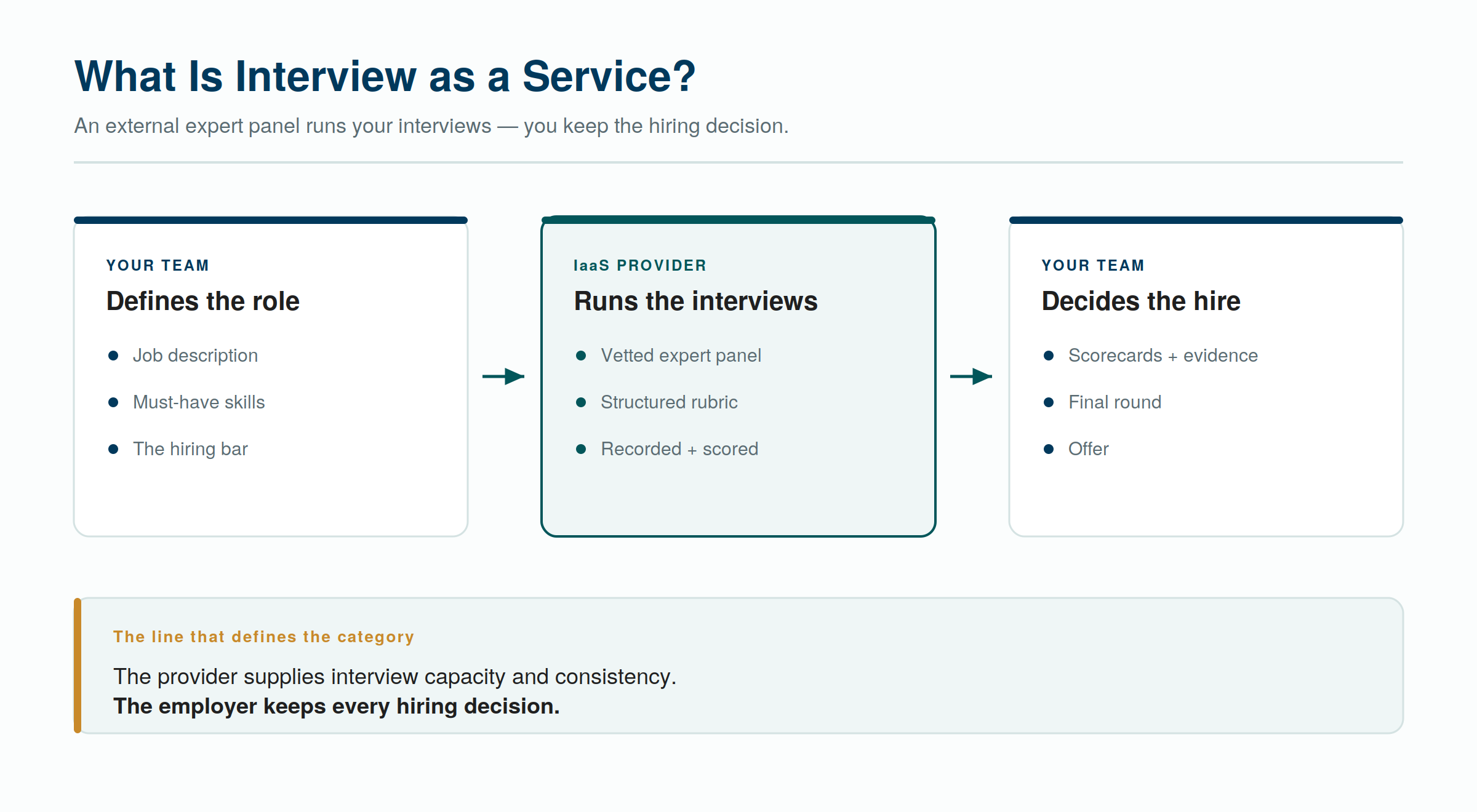
| What is interview as a service? Interview as a Service (IaaS) is a hiring model where an external provider conducts your candidate interviews using vetted expert interviewers, AI interviewers, or both — and returns structured, recorded scorecards. The provider supplies interview capacity and consistency; the employer keeps every hiring decision. |
What Is Interview as a Service?
Interview as a Service (IaaS) is a hiring model in which an external provider conducts candidate interviews on an employer’s behalf and delivers structured, recorded evaluations. The provider brings interviewers — human experts, AI interviewers, or a mix — along with the rubrics, scheduling, and reporting around them.
The category exists because of a specific bottleneck. Interviewing is skilled work performed by people whose main job is something else: senior engineers, managers, specialists. Every interview hour is an hour not spent shipping, and when hiring volume rises, either the calendar breaks or the process gets sloppy. IaaS separates interview capacity from your headcount.
One line worth remembering: the provider supplies the interview; the employer keeps the decision. Any vendor blurring that line is selling something else.
How Interview as a Service Differs From What It Gets Confused With
Most confusion about the category comes from three adjacent things it is not. The clearest way to see it: staffing agencies solve a pipeline problem, IaaS solves a bandwidth problem.
| Interview as a Service | Staffing agency | In-house panel | |
| What you get | Interviews conducted and scored | Candidates sourced and placed | Your own team’s time |
| Sources candidates? | No — you bring the pipeline | Yes — that’s the product | No |
| Who decides the hire | You, from the scorecards | You, from their shortlist | You |
| Typical pricing | Per interview conducted | % of first-year CTC | Salary cost of panel hours |
| Fixes | Interview bandwidth and consistency | Pipeline shortage | Nothing — it is the constraint |
It is also not an assessment platform. Assessment tools deliver tests and return scores automatically; IaaS delivers conducted interviews with a scorecard, and most teams run both — tests to filter, interviews to evaluate.
The Three Delivery Models
Providers deliver interview capacity in three shapes, and the differences matter more than the shared label. Human expert panels bring vetted domain interviewers to live rounds. AI-structured interviews ask every candidate the same questions against the same rubric. Agentic AI interviews go further, conducting, probing, and scoring autonomously at any hour.
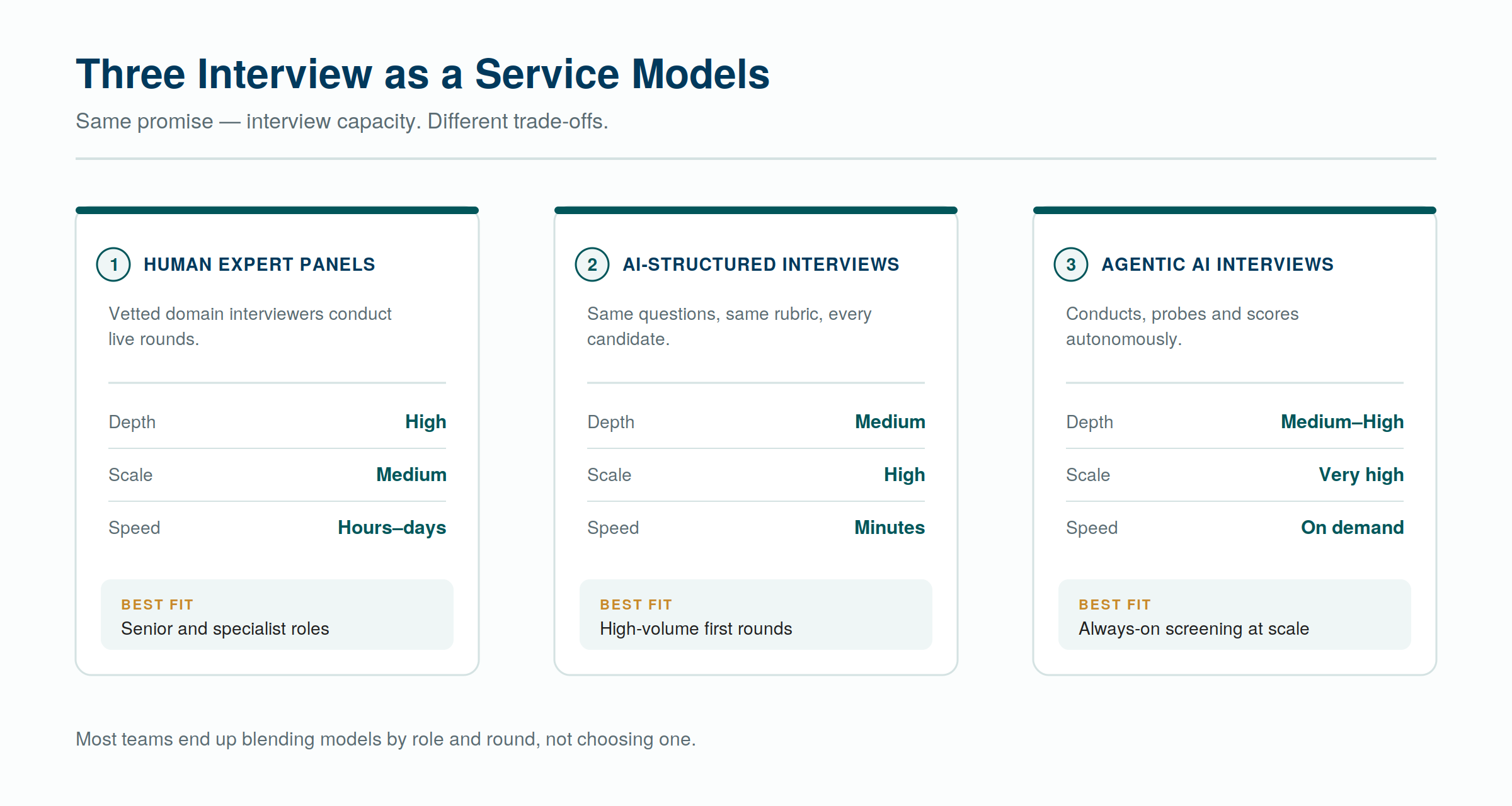
Most teams do not choose one. The common pattern is AI or agentic interviews for high-volume first rounds, expert human panels for senior and specialist roles, and in-house panels for finals — matched to the round, not adopted wholesale.
When Interview as a Service Makes Sense
The category fits a specific problem shape, and the honest version of this section includes where it does not.
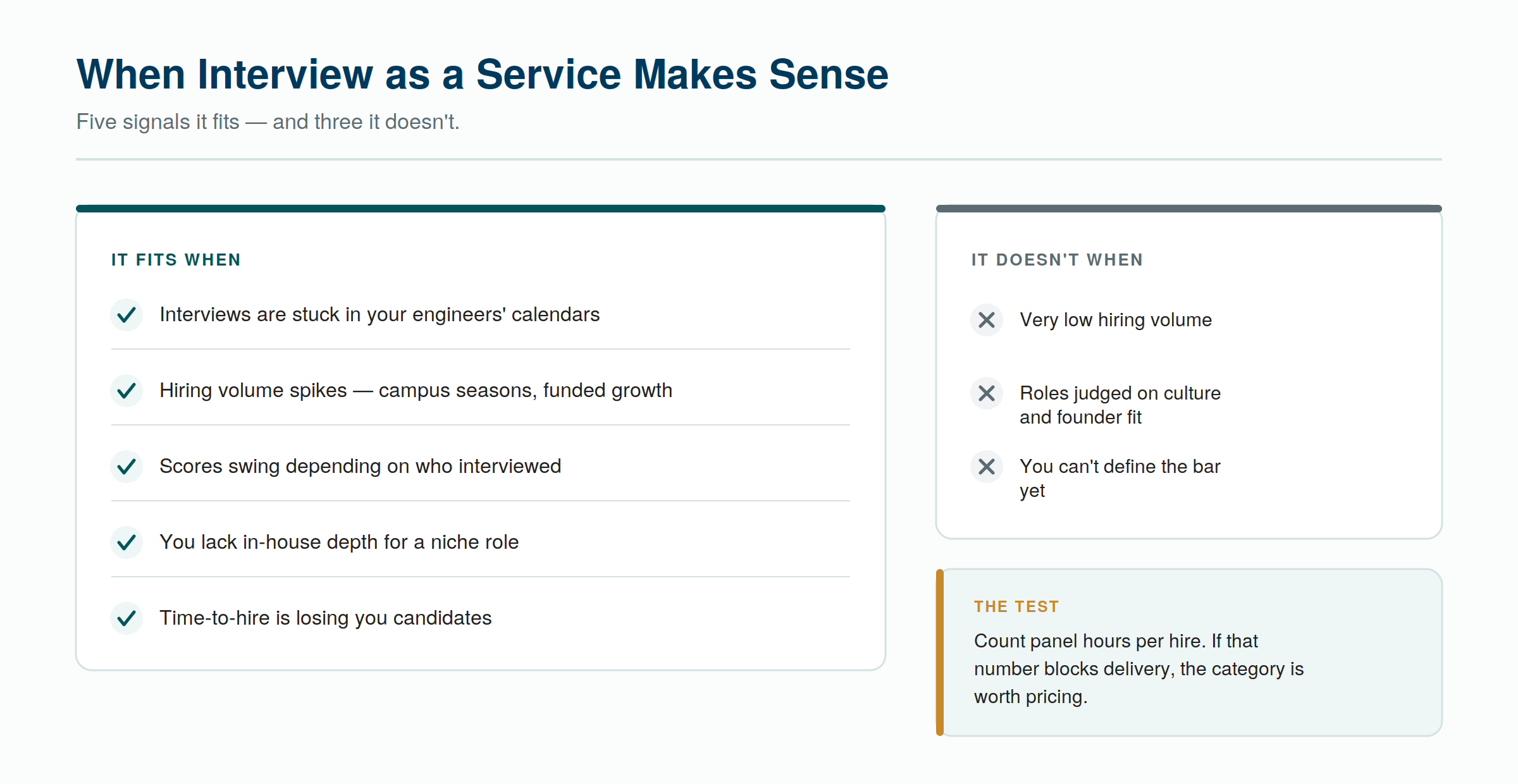
The clearest diagnostic is arithmetic: count interview hours per hire, multiply by the loaded cost of the people giving those hours, and add what that time displaced. If the answer changes your delivery roadmap, the category is worth pricing. High-volume campus hiring is where this math turns lopsided fastest — hundreds of first-round interviews compressed into a few weeks.
What to Check Before You Buy
Interviewer credentials and calibration. Ask who interviews, how they are vetted, and how scores stay consistent across different interviewers.
Recordings and scorecards. You should receive evidence, not a verdict — a rubric-scored card and a recording you can review.
Turnaround time. Ask for the actual median from request to completed interview, not the best case.
AI validation, where AI is used. Ask for human-agreement data on the scores. A vendor that cannot show it is asking you to trust an unvalidated judgement at scale.
Interview as a service is a narrow, useful idea wearing a broad-sounding name: someone else runs the interviews, to your bar, with evidence attached — and you still decide. It is worth pricing when interview hours have become the constraint on hiring, and worth skipping when they have not.
futuremug delivers all three models — expert interview panels, AI interviews, and agentic AI interviews — so the model can follow the role and the round rather than the other way around.



Frequently Asked Questions
It is outsourcing the interviewing, not the hiring. An external provider runs your interview rounds with vetted expert interviewers or AI interviewers and hands back structured scorecards with recordings. You still set the bar, and you still choose who gets the offer.
No — they solve opposite problems. A staffing agency finds candidates and is paid a percentage of salary when one is hired. An IaaS provider does not source anyone; it interviews the candidates you already have and charges per interview conducted. Teams short on pipeline need an agency; teams short on panel time need IaaS.
Pricing is usually per interview conducted, with rates varying by seniority, technical depth, and turnaround. The comparison that matters is against your own panel hours: interviewer time at a senior engineer's loaded cost, plus the delivery work those hours displaced.
On consistency, often better — structured rubrics and recorded rounds reduce the interviewer-to-interviewer variance most in-house processes carry. On context, in-house wins: nobody outside your company sells the role or reads team fit as well. Which is why most teams outsource early rounds and keep final rounds in-house.
Three profiles recur: fast-growing companies whose engineers are the interview bottleneck, teams hiring in bursts (campus seasons, post-funding sprints), and companies hiring for skills they do not have in-house to assess.