
How to Detect Cheating in Video Interviews: 2026 Playbook
Cheating in video interviews used to mean a sticky note out of frame. In 2026 it means an AI assistant in another window feeding fluent answers in real time — or, at the sharper end, a different person entirely taking the interview. Remote hiring made both easier, and they’re now common enough that every recruiter and panelist needs a way to spot them. This is that playbook: the tells to watch for, how to catch the two modern threats, the layered process that actually works, and how to do all of it without falsely accusing an honest candidate.
|
Quick answer: To detect cheating in a video interview, watch for the tells — eyes darting off-screen, reciting rather than answering, unnatural pauses, and answers that are too polished or generic — and layer four defences: verify identity, proctor the session, probe with adaptive follow-ups, and review the recording. The two 2026 threats are AI-assisted answers and fake candidates (impersonation), and both are beaten by the same move: a specific follow-up question that a script or a stand-in can’t survive. Crucially, no single tell is proof — corroborate before you conclude. |
The Tells: What Cheating Looks Like on Screen
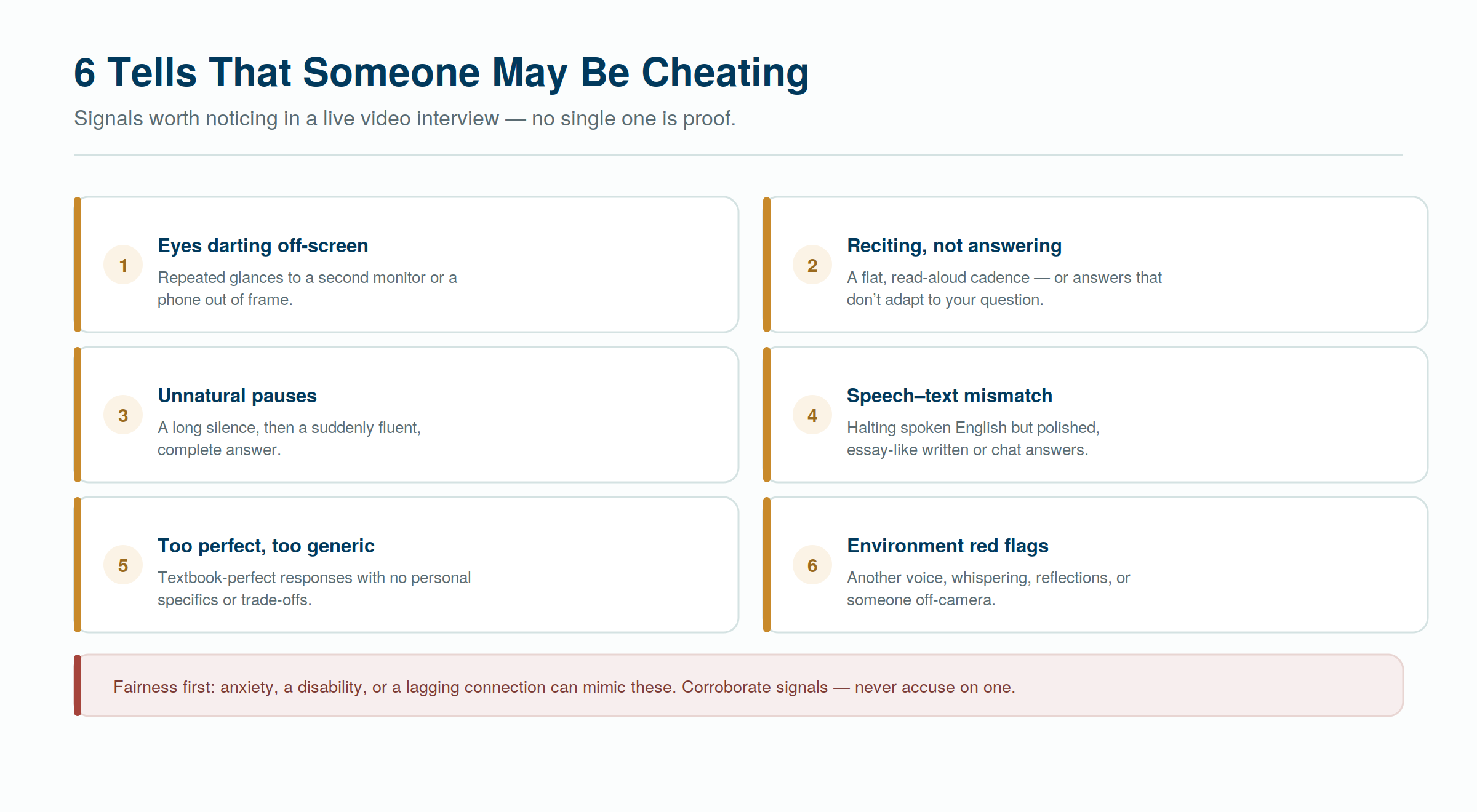
Most cheating leaves visible traces in a live interview. None is conclusive by itself — that caveat matters and we’ll come back to it — but a cluster of them is worth a closer look.
Eyes and attention. Repeated glances to the side or down suggest a second screen or a phone out of frame. A candidate reading an answer has a giveaway rhythm: their gaze tracks text rather than meeting the camera.
Cadence and timing. A flat, recited delivery, or a long pause followed by a suddenly complete and fluent answer, can indicate the response was fetched rather than formed. Real thinking sounds different from real reading.
Content and consistency. Answers that are textbook-perfect but generic — with no personal specifics, no trade-offs, no “it depends” — often aren’t the candidate’s own, especially when their spoken fluency doesn’t match the polish of their written or chat answers.
The Two 2026 Threats
Modern interview cheating comes in two distinct forms, and they call for different detection. It’s worth separating them, because a check that catches one may miss the other entirely.
AI-assisted answers
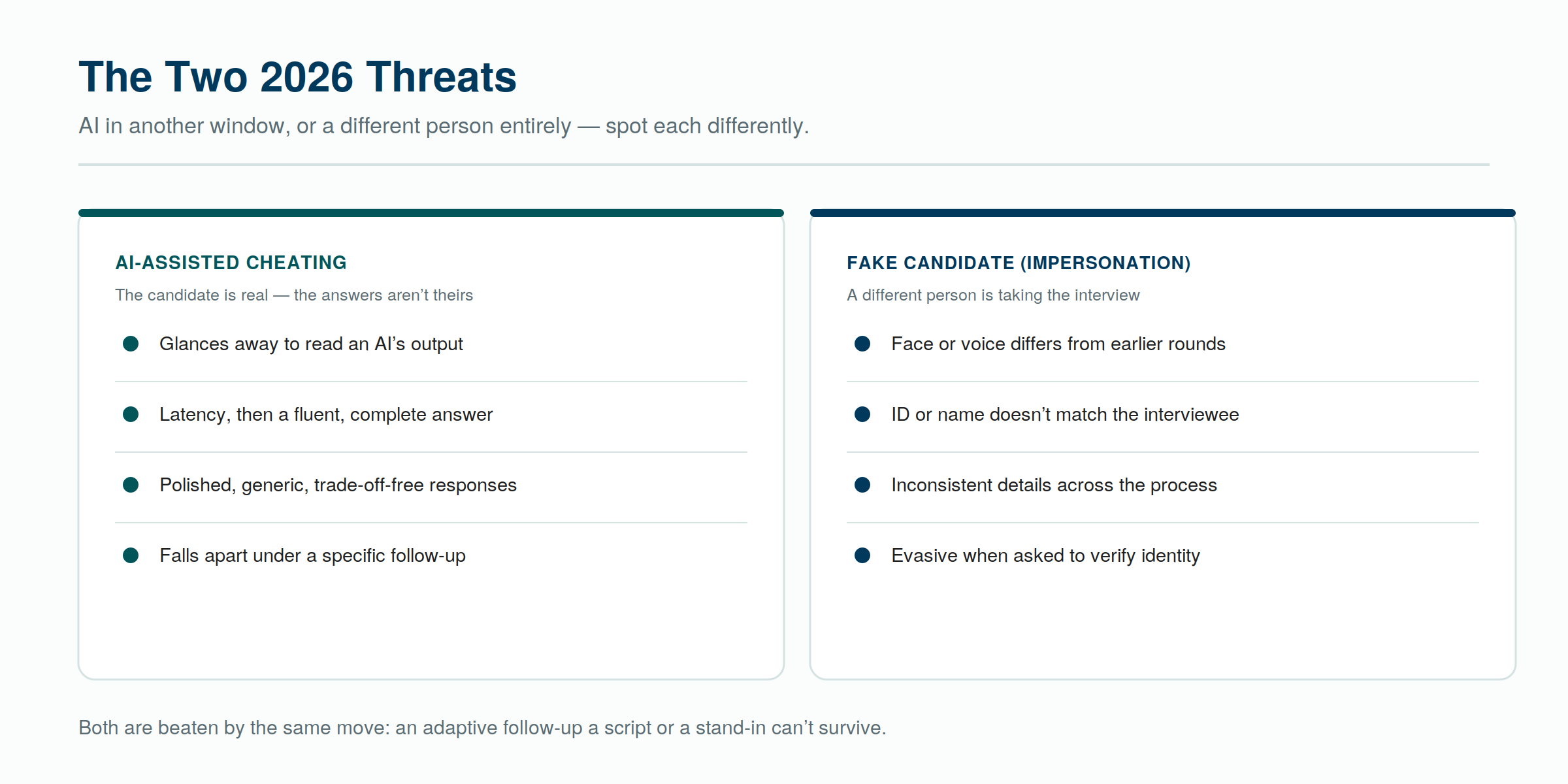
Here the candidate is real, but the answers aren’t theirs — they’re reading from an AI assistant. The tells are the glance away to read output, the latency before a fluent answer, and the polished-but-generic quality of responses. The reliable test is a pointed follow-up: ask them to justify a specific choice or handle an edge case. An answer produced in another window rarely survives the second question.
Fake candidates and impersonation
Here a different person is taking the interview altogether. The tells are a face or voice that doesn’t match earlier rounds, an ID that doesn’t match the person on screen, details that shift across the process, and evasiveness about verifying identity. The defence is verification up front and continuity: keep the same interviewer across rounds where you can, so a substitution stands out, and ask about resume specifics only the real person would know.
The reassuring part: both threats fall to the same move. A specific, adaptive follow-up question defeats a script, an AI in another window, and a stand-in alike — because none of them can improvise the way genuine knowledge does.
The Anti-Cheating Playbook
Individual tells are useful, but reliable detection comes from a system — four layers that back each other up, so you’re never depending on a single signal or a single tool.
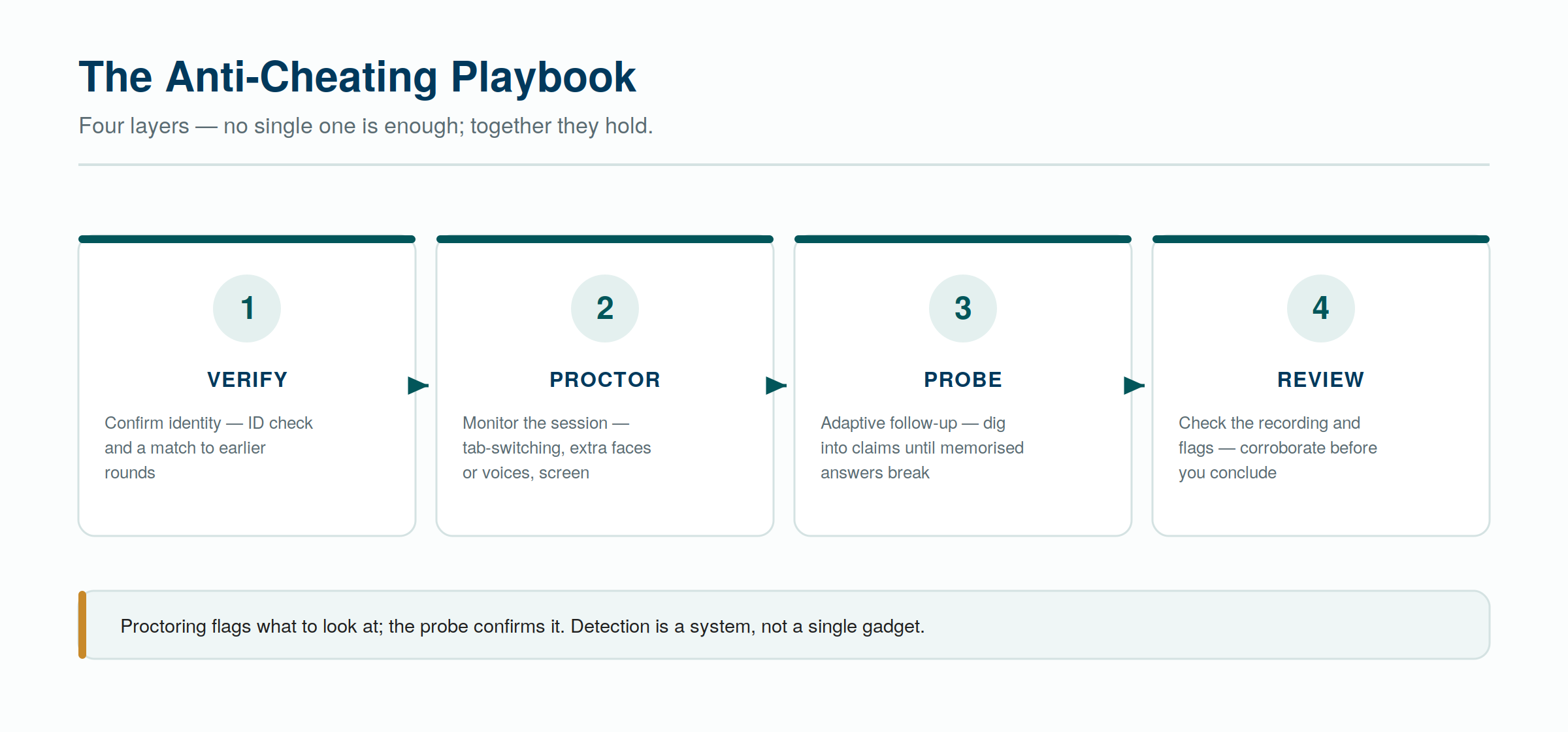
Verify and proctor set the stage. Confirm identity at the start, and use proctoring to monitor the session — technical proctoring can flag tab-switching, extra faces or voices, and screen activity, telling you where to look. Proctored AI interviews and assessments automate this layer at scale.
Probe and review confirm the truth. Proctoring flags what to examine; the probe confirms it. Adaptive follow-up questions — the kind agentic interviews apply automatically — test whether the candidate actually knows what they claimed, and the recording lets you corroborate a flag before drawing any conclusion. Together these four layers catch far more than any one of them alone.
Stay Fair: Detection Without False Accusations
This is the part it’s dangerous to skip. Every tell in this playbook has an innocent explanation. Anxiety makes people look away and freeze. A disability or neurodivergence can change eye contact, cadence, and phrasing. A poor connection creates the exact latency that looks like fetching an answer. Looking away or pausing is not evidence of cheating — it’s evidence of being human on camera.
So the rule is simple: never act on a single signal. Corroborate several independent ones, treat proctoring flags as prompts to look closer rather than verdicts, and always give the candidate a fair chance to demonstrate their knowledge through follow-ups before concluding anything. A fair process protects honest candidates from false accusations — and, not incidentally, makes your genuine detections far more defensible if they’re ever challenged.
Detecting cheating in video interviews in 2026 isn’t about one clever trick — it’s about knowing the tells, understanding the two threats, and layering verification, proctoring, probing, and review so no single gap lets someone through. The single most powerful tool is the oldest one: a specific follow-up question that genuine knowledge can answer and a script, an AI, or a stand-in cannot. Build that into a fair, corroborated process, and you protect the integrity of your hiring without putting honest candidates under suspicion.
futuremug builds this in by default — proctored, structured AI interviews with agentic follow-up that probes beyond memorised answers, plus recorded evidence to corroborate any flag. If interview integrity at scale is the concern, that combination of proctoring and probing is what makes cheating hard and detection fair.



Frequently Asked Questions
Combine behavioural tells with a layered process. The tells include eyes repeatedly darting off-screen, a flat reciting cadence, long pauses followed by suddenly fluent answers, a mismatch between halting speech and polished written answers, and textbook-perfect responses with no personal detail. The process is four layers: verify the candidate's identity, proctor the live session, probe their answers with adaptive follow-ups, and review the recording. No single signal is conclusive — the point is to corroborate.
The tells of AI-assisted answers are a glance away to read output, a beat of latency before a fluent and complete response, and answers that are polished but generic, with no trade-offs or personal specifics. The most reliable test is a pointed follow-up: ask them to justify a choice, walk through an edge case, or explain a decision in their own words. Answers generated in another window tend to fall apart when the next question wasn't one the AI was prompted for.
Look for a face or voice that differs from earlier rounds, an ID or name that doesn't match the person on screen, details that shift across the process, and evasiveness when asked to verify identity. The defence is verification: confirm identity at the start, keep the same interviewer across rounds where possible so a substitution is noticeable, and ask specific questions about the experience on the resume that only the real person could answer.
Proctoring helps, but it isn't a complete answer on its own. Technical proctoring can flag tab-switching, additional faces or voices, and screen activity — it tells you where to look. What confirms cheating is human or agentic probing that tests whether the candidate actually knows what they claimed. Proctoring plus probing is far stronger than either alone; treat detection as a system, not a single gadget.
By never acting on one signal. Anxiety, a disability, neurodivergence, a bad connection, or simple nervousness can all mimic the tells of cheating — looking away or pausing is not proof of anything. Corroborate multiple independent signals, give the candidate a fair chance to demonstrate their knowledge through follow-ups, and treat proctoring flags as prompts to look closer, not verdicts. Fair process protects honest candidates and makes genuine detection more defensible.
Design interviews that are hard to cheat: use adaptive, probing questions rather than predictable ones, ask for reasoning and trade-offs rather than recall, and pair the interview with a proctored, structured setup. AI-structured interviews and proctored assessments make cheating harder by default — prevention beats detection, and a well-designed interview does both.