How to Evaluate Agentic AI Interviewing Platform for Faster Candidate Screening

What is an agentic AI interviewing platform?

An agentic AI interviewing platform uses an AI interviewer to plan and conduct a candidate interview around a defined hiring objective. It can ask a question, listen to the response, identify a claim or gap, ask a relevant follow-up, record the exchange, and produce an evaluation for human review.
This is different from a static questionnaire that reads the same list to every candidate. It is also different from an AI summary tool that only processes notes after a human interview.
A useful agentic interview has a controlled loop:
  1. Understand the role: Translate the job description into skills, priorities, and expected proficiency.
  2. Plan the interview: Select questions and probes that can produce evidence for those skills.
  3. Conduct the conversation: Ask, listen, clarify, and follow up within defined boundaries.
  4. Capture evidence: Record the candidate’s answers, examples, reasoning, and demonstrated depth.
  5. Score against the rubric: Map evidence to skills and confidence levels.
  6. Escalate uncertainty: Route borderline results, niche skills, or low-confidence cases to a human expert.
  7. Support a decision: Give the hiring team an evidence-linked report rather than an unexplained score.
The word agentic should therefore describe an observable operating capability, not only a product label. During a demo, ask the vendor to show what the system does after a candidate makes a claim, gives an incomplete answer, or contradicts the resume.

How agentic AI interviewing differs from scripted AI interviews

Interview model
What it does
Main limitation or strength
Scripted questionnaire
Asks a fixed sequence of questions
Predictable, but may not test claims deeply
AI-assisted human interview
Helps a human with questions, notes, or summaries
Keeps human conversation, but still needs interviewer capacity
Conversational AI interview
Conducts a spoken or video interview
Can increase screening capacity and standardization
Agentic AI interview
Plans from the role, asks, listens, follows up, scores, and escalates
Can gather deeper evidence, but requires strong controls and evaluation
Human expert interview
Uses expert judgment for technical, leadership, or niche evaluation
Rich judgment, but limited by panel availability and cost
The models can coexist. An agentic AI interview may perform the first round, then send the shortlist and a probe list to an expert interviewer. A human panel can validate the most important or uncertain skills. The hiring team should remain responsible for the final decision.

Why teams evaluate agentic AI interviewing platforms

Engineers lose time to repetitive first-round interviews

A technical interview can require substantial engineering time. When many candidates are not yet ready for a deep expert round, the organization may spend senior capacity on repeated basics instead of high-value technical judgment.

Candidate volume grows faster than interviewer capacity

Hiring campaigns, graduate hiring, new delivery centers, and urgent project staffing can create more screening demand than internal panels can absorb. An agentic AI interviewer can provide a consistent first-round experience at a larger volume, subject to the vendor’s capacity and service design.

Strong candidates wait for a panel

When panels are fully booked, qualified candidates may exit the funnel before the organization completes its evaluation. A browser-based AI interview with flexible availability can shorten the wait for an initial signal.

Resumes do not show demonstrated depth

A resume may mention a framework, language, or cloud service without proving how the candidate used it. Dynamic follow-ups can test a claim by asking about measurement, trade-offs, failure modes, decisions, and results.

Interview standards vary across human interviewers

A shared AI flow can reduce variation in first-round questions and scoring. It does not remove the need for rubric design, calibration, candidate support, or human review.

9 evaluation criteria for an agentic AI interviewing platform
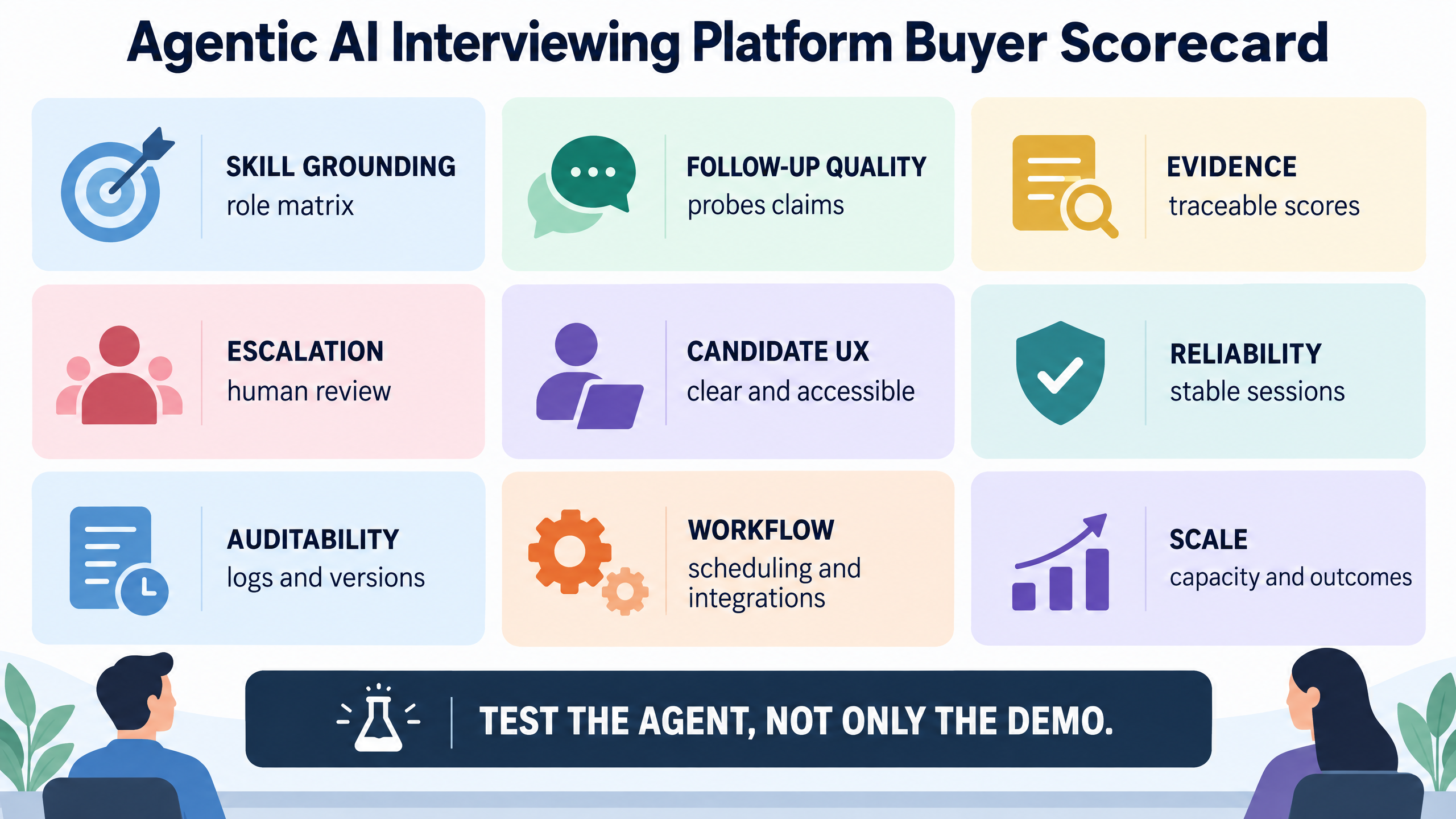
Agentic AI interviewing platform buyer scorecard covering skill grounding, dynamic follow-ups, evidence, escalation, candidate experience, reliability, reporting, workflow, and scale

1. Job-description and skill-matrix grounding

The platform should start from the role rather than from a generic interview template.
Ask whether it can:
  • Import or create a job description.
  • Identify mandatory and preferred skills.
  • Set proficiency expectations.
  • Prioritize skills by hiring importance.
  • Distinguish overall experience from niche-skill depth.
  • Map questions and follow-ups to each skill.
  • Set a pass bar or escalation threshold.
  • Allow a recruiter or hiring manager to edit the skill matrix.
A good demo should show a skill from the job description moving through the entire system: skill priority, interview question, candidate answer, follow-up, score, evidence, and recommendation.
Do not accept a match percentage without understanding the matrix behind it. A candidate may have many years of overall experience but limited evidence for the skill that matters most to the role.

2. Dynamic follow-up quality

Dynamic follow-ups are the defining feature to test. The agent should not simply ask unrelated questions after every answer. It should follow the candidate’s evidence and stay within the interview objective.
Use a test prompt such as:
“I improved API performance by 40%.”
A useful follow-up might ask how the improvement was measured, what bottleneck was identified, which change was made, and what trade-off resulted. The platform should record the answer as evidence rather than treating the original percentage as proven fact.
Evaluate whether the agent can:
  • Detect a claim that needs clarification.
  • Ask a relevant follow-up.
  • Avoid repeating a question.
  • Adjust depth based on the candidate’s answer.
  • Return to a required skill if evidence is incomplete.
  • Stop probing when sufficient evidence is gathered.
  • Handle “I don’t know” without creating a confusing loop.
  • Preserve a respectful and understandable conversation.
Ask for examples of irrelevant, evasive, contradictory, and exceptional answers. The agent should have a defined response policy for each.

3. Evidence-linked scoring

The report is more important than the avatar or voice. A hiring manager should be able to see why the platform assigned a score.
Look for an evidence chain such as:
Skill → question → candidate answer → extracted evidence → score → confidence → recommendation
Evaluate whether the report includes:
  • Skill-level scores.
  • Supporting excerpts or transcript locations.
  • Strengths and gaps.
  • Confidence indicators.
  • Mandatory-skill failures.
  • Contradictions or uncertainty.
  • Follow-up recommendations.
  • Overall recommendation with rationale.
  • Transcript and recording access where applicable.
  • Assessment version and rubric version.
A report should distinguish between a candidate stating a skill and demonstrating applied knowledge. It should also make uncertainty visible. A low-confidence score should lead to review or escalation, not false precision.

4. Human escalation and decision control

An agentic AI interviewing platform should tell you when not to trust its own conclusion.
Define escalation rules for:
  • Low confidence.
  • Niche or emerging skills.
  • Leadership and senior roles.
  • Contradictory answers.
  • High-impact hiring decisions.
  • Accommodation requests.
  • Technical failures.
  • Integrity concerns.
  • Candidate appeals or complaints.
  • Evidence that does not fit the rubric.
The human reviewer should receive the AI’s evidence and suggested probe list. This lets the expert begin with the uncertainty rather than repeating the entire first round.
The final hiring decision should remain with the organization. The AI’s role is to increase the quality and speed of screening evidence, not to remove accountability.

5. Candidate experience and accessibility

Candidates may accept an AI interview when the format is clearly explained and easy to access. They may reject it when it feels like an undisclosed experiment or an opaque gate.
Review the candidate journey:
  • Is the AI format disclosed?
  • Does the candidate know the expected duration?
  • Can the candidate test the camera, microphone, and browser?
  • Is there a one-click browser join without unnecessary installation?
  • Are instructions and consent clear?
  • Are captions or accessible alternatives available?
  • Can a candidate request an accommodation?
  • Is there a support route during the interview?
  • Does the completion screen explain what happens next?
  • Can the candidate report a technical or process concern?
The provide a useful baseline for accessible web interaction, including meaningful structure, keyboard operation, input purpose, and understandable error support . Accessibility must be tested in the actual interview experience, not assumed from a vendor’s general product statement.

6. Technical reliability and interview integrity

An agentic interview requires reliable audio, video, transcripts, question delivery, and session state. A poor connection should not silently turn into a poor evaluation.
Ask how the platform handles:
  • Microphone or camera failure.
  • Temporary network interruption.
  • Browser refresh.
  • Candidate re-entry.
  • Transcript gaps.
  • Accent or language variation.
  • Background noise.
  • Multiple speakers.
  • Identity or face checks.
  • Screen sharing where required.
  • Recording consent and retention.
  • Interview abandonment.
Integrity controls should be proportionate to the role and transparent to candidates. If face verification, screen sharing, or off-tab tracking is used, candidates should understand what is checked and how exceptions are reviewed.

7. Reporting and auditability

A trustworthy platform should help the organization reconstruct how a recommendation was produced.
Evaluate whether it retains:
  • Job description or skill matrix version.
  • Interview plan and rubric version.
  • Questions and follow-ups asked.
  • Candidate answers and timestamps.
  • Transcript and recording settings.
  • Scores and confidence levels.
  • Human edits or overrides.
  • Escalation events.
  • Access and change history.
  • Report version.
  • Retention and deletion status.
Ask who can edit questions, change pass bars, alter skill priorities, approve a candidate, or access recordings. Role-based access and audit logs are especially important when recruiters, hiring managers, clients, and external interviewers share the system.

8. Workflow, scheduling, and integration

The value of agentic AI interviewing comes from the workflow around the conversation.
Look for:
  • Resume-to-job-description matching.
  • Optional assessment before the interview.
  • Candidate invitations.
  • Browser-based access.
  • Automated scheduling.
  • Candidate and interviewer notifications.
  • Secure join links.
  • Recruiter dashboards.
  • Human expert escalation.
  • ATS or API integration.
  • Shortlist views.
  • Reports and exports.
  • Status tracking from invite to decision.
A platform that produces a clever interview but leaves recruiters to manually move every candidate into the next stage may not solve the operational bottleneck.

9. Scale, service levels, and measurable outcomes

Ask the vendor to define capacity in operational terms:
  • Interviews per day and per hour.
  • Peak concurrency.
  • Supported languages and roles.
  • Scheduling turnaround.
  • Report turnaround.
  • Support coverage.
  • Expert escalation capacity.
  • Data and recording retention.
  • Pilot limits.
  • Pricing unit.
  • Usage-based credits or subscriptions.
  • Service-level commitments.
futuremug’s provider pages publish scale indicators including 5,000+ verified expert interviewers, 250+ IT domains, 500+ daily interviews, 140K+ interviews, and 4-hour scheduling turnaround on its interview-outsourcing service page. These are provider-published figures. Ask how each metric is defined, measured, dated, and connected to the intended use case.
The futuremug agentic AI interview page also describes a pilot model that can run on a live job description, a pay-on-answer approach, browser-based access without installation, and a path from AI screening to expert escalation. Confirm current commercial terms, availability, and plan-specific features before using these details in a campaign.

A practical evaluation workflow

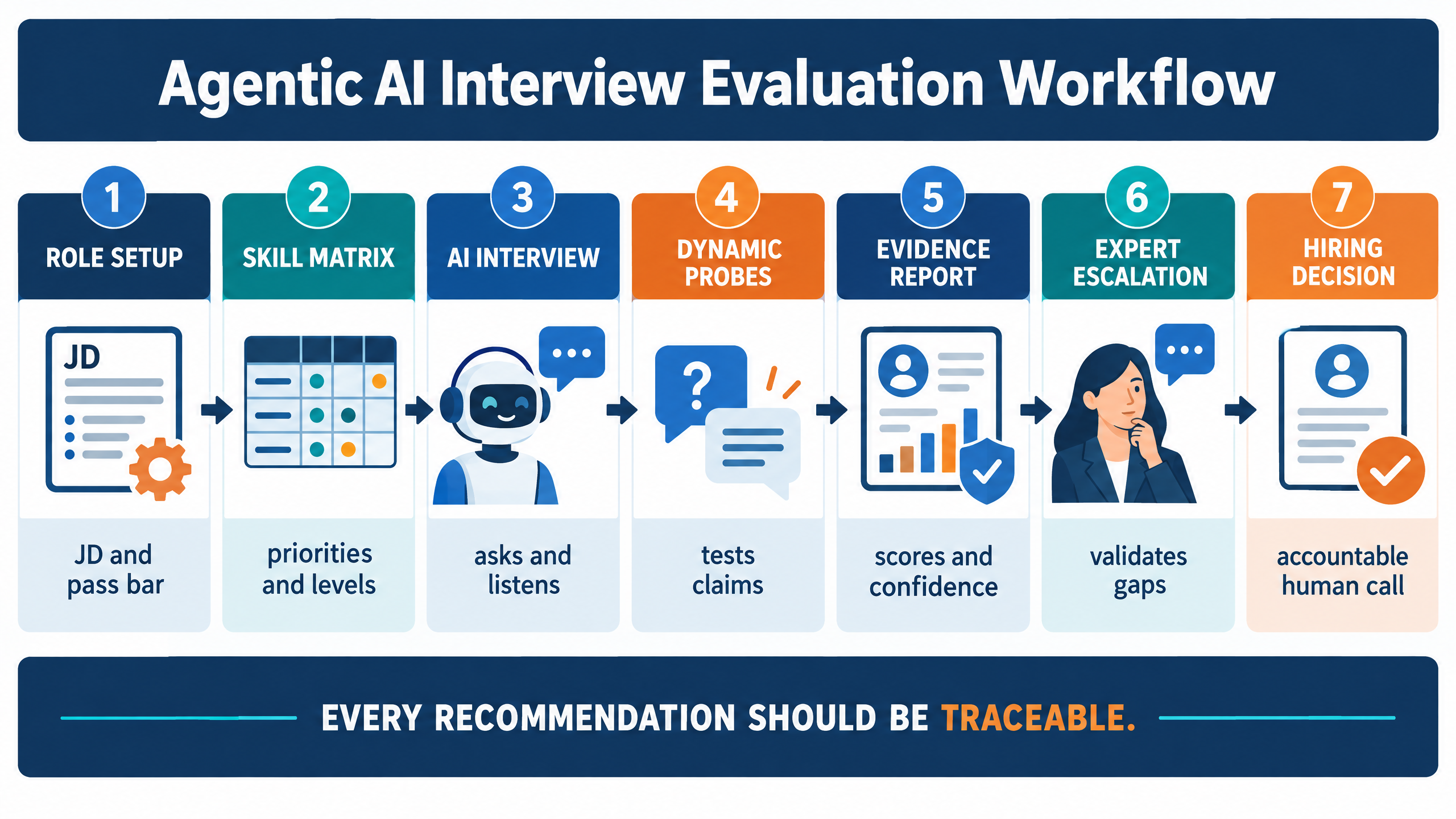
Agentic AI interviewing platform evaluation workflow from role setup to dynamic interview, evidence report, human escalation, and hiring decision


Step 1: Choose a representative role

Use a role with real hiring volume and meaningful technical or functional requirements. Provide the job description, candidate profile, seniority, mandatory skills, preferred skills, and pass bar.

Step 2: Define success before the demo

Set measurable criteria such as screening turnaround, recruiter review time, expert-panel utilization, candidate completion, report usefulness, escalation accuracy, and downstream interview conversion.

Step 3: Observe the setup

Ask the vendor to create the skill matrix from the job description. Check whether a recruiter or hiring manager can edit priorities, expected proficiency, and unacceptable gaps without vendor intervention.

Step 4: Run contrasting candidate scenarios

Test a strong candidate, a candidate with a resume claim but shallow knowledge, a candidate with an unusual career path, a candidate who says “I don’t know,” and a candidate who has a technical issue.

Step 5: Inspect the evidence report

Trace two or three scores back to the exact questions and candidate answers. Check whether the report shows confidence, gaps, and recommended probes. Ask whether a hiring manager can understand it in a short review.

Step 6: Trigger human escalation

Create a low-confidence or niche-skill case. Confirm that the expert reviewer receives the transcript, evidence, unresolved questions, and rubric rather than starting without context.

Step 7: Review governance and data controls

Ask about consent, recordings, transcripts, access, retention, deletion, audit logs, model or feature changes, human overrides, and candidate support.

Step 8: Run a limited pilot

Start with a defined role and a measurable candidate cohort. Compare the agent’s recommendations with trained human review and track false positives, false negatives, candidate experience, and downstream outcomes.

How futuremug approaches agentic AI interviews

futuremug’s describes a model in which an AI interviewer screens technical candidates against a job description, asks dynamic follow-ups, produces evidence-linked scoring, and escalates shortlisted candidates to 5,000+ verified expert interviewers when human depth is needed.
The page describes a flow that can include:
  1. Job-description and applicant intake.
  2. Resume-to-JD matching.
  3. Optional coding or skills assessment.
  4. Agentic AI interview.
  5. Evidence report and AI shortlist.
  6. Expert interview for validation.
  7. Hiring-team decision.
The provider describes agentic interviews with conversational AI, dynamic follow-up questions, real-time transcripts, skill-matrix grounding, confidence levels, skill-gap identification, and human escalation. It also describes browser access without installation, emailed one-click join links, consent before starting, live captions, and a completion screen.
The evidence-report examples on the page show competency scores tied to candidate answers, confidence levels, skill gaps, and recommendations such as escalating to an expert. Treat these as product examples and provider-published capabilities. During a buyer evaluation, test the flow using the organization’s own job description and candidate scenarios.
futuremug’s broader describes automated scheduling, live video interviews, coding workflows, AI-generated interview questions, AI resume-to-JD matching, centralized reporting, transcripts, summaries, and notifications through email, SMS, and WhatsApp.
The provider also publishes a claim that its AI-powered interview platform can reduce time-to-hire by 50%. This is a provider-stated result, not a universal guarantee. Ask for the baseline, cohort, time period, role type, and measurement method before using the number in a buyer case or campaign.
For a controlled pilot, and provide one live job description, a representative candidate sample, the mandatory skills, the human escalation rules, and the expected screening volume. Ask to inspect the full chain from role setup to final evidence report.

Frequently Asked Questions

Is an agentic AI interviewing platform the same as an automatic hiring system? ▼

No. An agentic platform can conduct and evaluate an interview, but the hiring organization should define how its output is used. A responsible design keeps humans accountable for final decisions, exceptions, senior roles, and cases outside the AI’s confidence.

What should human reviewers see? ▼

Reviewers should see the role requirements, skill matrix, interview questions, candidate responses, supporting evidence, scores, confidence indicators, unresolved gaps, and recommended follow-up. The reviewer should be able to challenge or qualify the AI output.

Can the AI ask biased or irrelevant questions? ▼

Yes, if the role specification, question-generation process, or follow-up rules are weak. Test the platform with representative roles and candidate answers. Require controls for prohibited or irrelevant questions, human review, versioning, and escalation.

How can a company validate an agentic AI interviewer? ▼

Run a pilot against a representative sample. Compare AI evidence and recommendations with trained human reviewers. Measure agreement, disagreement, escalation quality, candidate completion, technical failures, and downstream hiring outcomes. Review cases where the AI was uncertain or wrong.

Should an AI interview be used for every candidate? ▼

Not necessarily. Use it where the interview objective is clear, the candidate population can access the experience, the skills can be evaluated through the format, and human escalation is available. Do not force an AI interview into a role that needs a different type of evidence.

How should companies handle candidate consent and recordings? ▼

Explain the format, AI involvement, recording or transcript behavior, data use, retention, support route, and next steps before the interview. The exact notice and consent requirements depend on the organization’s jurisdictions and use case.

What does “evidence-linked scoring” mean? ▼

It means a score can be traced back to the candidate’s response and the skill or rubric criterion being evaluated. The hiring team can inspect why the system assigned a score instead of accepting an unexplained recommendation.

When should an AI interview escalate to an expert interviewer? ▼

Escalate when the AI has low confidence, the skill is niche, the role is senior or leadership-oriented, the candidate’s answers are contradictory, an integrity or accommodation issue appears, or the decision has a high consequence that requires human judgment.

How does NIST guidance apply to agentic AI interviewing? ▼

The NIST AI Risk Management Framework is a voluntary framework for managing risks to individuals, organizations, and society and for incorporating trustworthiness into the design, development, use, and evaluation of AI systems . For hiring, its governance mindset supports clear ownership, risk mapping, measurement, monitoring, and management of AI-assisted decisions.

Leave a Reply

Your email address will not be published.