
Technical Interview Outsourcing: How It Works, Costs & When to Use It
What Is Technical Interview Outsourcing?
Technical interview outsourcing, also called technical interview as a service, is when an external partner conducts some or all of your technical interview rounds. The partner supplies experienced engineers who interview candidates in their own field, using your job requirements and an agreed rubric.
It usually covers:
- Coding interviews: live problem-solving in a shared editor.
- System design interviews: architecture and scaling discussions for senior roles.
- Domain and stack interviews: deep dives into a specific technology, such as Java, React, DevOps, data engineering or SAP.
- Managerial technical rounds: for engineering leads and architects.
You stay in control of the final decision. The partner handles the time-consuming middle of the funnel.
How Technical Interview Outsourcing Works
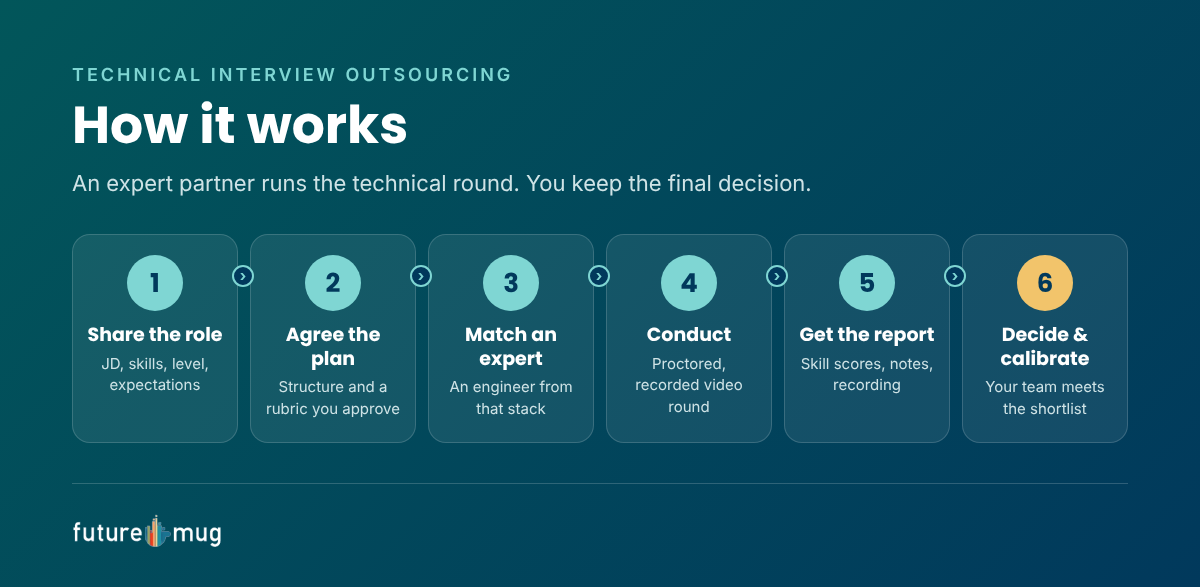
- Share the role. Send the job description, the skills to test, the level and your scoring expectations.
- Agree the interview plan. The provider proposes a structure, such as 60 minutes of coding plus 30 minutes of design, and a rubric you sign off.
- Match an expert interviewer. An engineer who works in that stack is assigned to each candidate.
- Schedule and conduct. The interview runs over video, usually proctored and recorded.
- Receive the report. You get skill-wise scores, written notes, the recording and a clear recommendation.
- Decide and calibrate. Your team meets the shortlisted candidates and gives feedback, so the rubric stays aligned with your bar.
Technical Interview Outsourcing Costs
Common pricing models
| Model | How it works | Best for |
|---|---|---|
| Per interview | A fixed fee for each completed interview, often varying by seniority and length | Irregular or project-based hiring |
| Package or credits | A block of interviews bought upfront at a lower unit rate | Steady monthly hiring |
| Subscription | A monthly or annual fee for a set volume and service level | High-volume, year-round hiring |
| Drive-based | A quote for a full campus or bulk-hiring drive | Campus and ramp-up hiring |
What drives the price up or down:
- Seniority: architect and senior rounds cost more than fresher rounds.
- Skill rarity: niche stacks need scarcer interviewers.
- Interview length and format: a 90-minute system design round costs more than a 45-minute coding screen.
- Turnaround and volume: urgent scheduling costs more, and higher volumes usually lower the unit rate.
The hidden cost of in-house interviewing
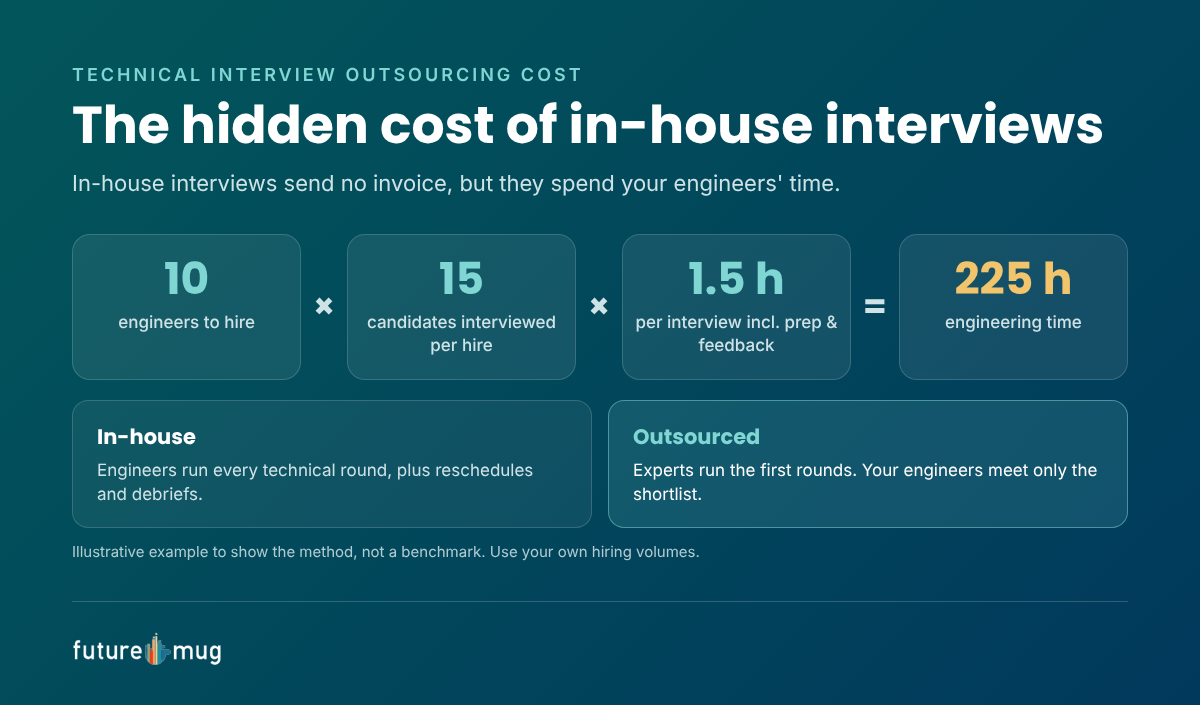
In-house interviews look free because no invoice arrives. They aren’t. Each interview takes engineer time for preparation, the interview itself, feedback and debriefs. That time comes out of product work.
An illustration: say you are hiring 10 engineers this quarter and interview 15 candidates per hire in the technical rounds. That’s 150 interviews. At about 1.5 hours each, including preparation and feedback, that’s 225 engineering hours, more than a month of one senior engineer’s full-time work. And that’s before rescheduling, no-shows and debriefs.
To compare fairly, multiply those hours by your engineers’ loaded hourly cost, then add the value of delayed roadmap work. Set that against a provider’s quote for the same volume.
The numbers above are an example to show the method, not a benchmark. Use your own hiring volumes.
When to Outsource Technical Interviews (and When Not To)
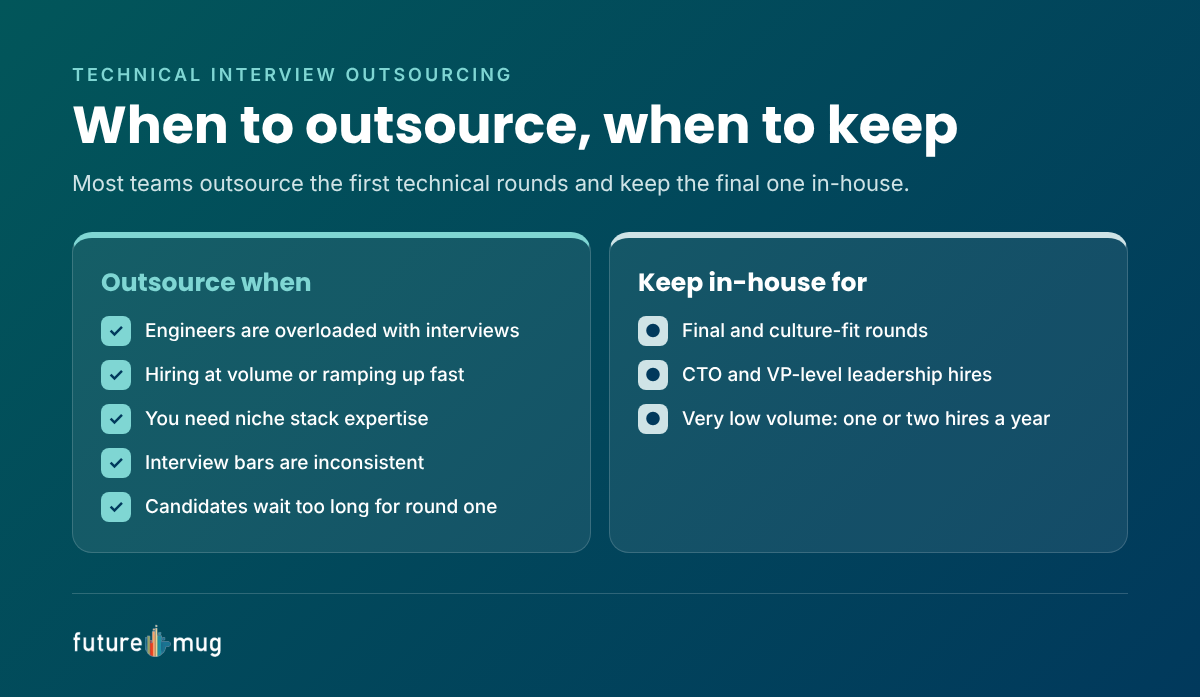
Outsource when
- Your engineers are overloaded. Interviews are delaying sprints or burning people out.
- You’re hiring at volume. A campus drive, a new project or a fast ramp-up.
- You need niche expertise. Your team doesn’t have deep knowledge of the stack you’re hiring for.
- Your process is inconsistent. Different interviewers set very different bars.
- Candidates are waiting too long. Slow first rounds lose good candidates to faster offers.
Keep in-house when
- Final and culture rounds. The team the candidate will join should meet them.
- Very senior leadership hires. A CTO or VP of Engineering hire needs your leadership involved throughout.
- Very low volume. One or two hires a year may not justify setting up a partner.
Most teams use a mix: outsource the first one or two technical rounds, and keep the final round in-house.
Benefits and Risks
| Benefits | Risks, and how to manage them |
|---|---|
| Frees engineering time for product work | Misaligned bar: agree a rubric upfront and calibrate on the first few candidates |
| Faster time to hire | Candidate experience: check interviewer professionalism and ask for candidate feedback |
| Consistent, structured evaluation | Data security: confirm how recordings and candidate data are stored and shared |
| Access to niche expertise | Over-reliance: keep final rounds and hiring decisions with your team |
| Scales up and down with demand | Proxy candidates or cheating: require proctoring and identity checks |
How to Choose a Provider
Ask every provider these questions:
- Domain coverage: do you have interviewers for every stack we hire for, including niche ones?
- Interviewer vetting: how are interviewers selected, trained and calibrated? Can we see sample profiles?
- Rubric control: can we define or approve the questions and scoring?
- Turnaround: how fast can you schedule, and when do reports arrive?
- Report quality: can we see a sample report with scores, notes and a recording?
- Integrity: what proctoring and identity checks do you use?
- Security: where are recordings stored, and who can access them?
- Beyond interviews: can you also run assessments or AI screening before the technical round?
Comparing vendors? See our list of the best interview-as-a-service platforms in India.
Run a two-week pilot
Send one open role to your shortlisted provider. Have one of your engineers shadow the first two or three interviews, compare the provider’s recommendations with your own team’s judgement, and track turnaround and candidate feedback. Scale up only once the bar matches yours.
Why Engineering Teams Choose futuremug
futuremug’s interview outsourcing service runs technical rounds for companies across India:
- 5,000+ expert interviewers across 250+ IT domains, so niche stacks are covered by people who work in them.
- Structured rubrics and reports: skill-wise scores, notes, recordings and a clear recommendation.
- Proctored video interviews to protect against proxy candidates.
- Screening before the technical round: online assessments and AI video interviews filter applicants first, so expert interview time goes to the right candidates.
- Campus and bulk drives: assessments, AI interviews and expert rounds run together for high-volume hiring.
Conclusion
Technical interview outsourcing frees your engineers, speeds up hiring and makes evaluation more consistent, as long as you choose a provider with real domain depth, agree the rubric upfront and keep final rounds in-house. Work out your true in-house interview cost, run a short pilot, and scale once the bar matches yours.
Book a futuremug interview outsourcing demo and send us your next open tech role.



Frequently Asked Questions
It is when an external partner runs your technical interview rounds, such as coding, system design or domain interviews, with its own expert engineers, and sends you a scored report and recommendation.
Providers usually charge per interview, sell packages or subscriptions, or quote per hiring drive. The price depends on the role's seniority, how rare the skill is, the interview's length, turnaround and volume. Compare it with the engineering hours your team currently spends on interviews.
Yes, when the provider uses domain-matched interviewers, a rubric you agree, proctoring and recordings, and when you calibrate on the first few candidates.
Most teams outsource the first one or two technical rounds and keep the final round, culture fit and leadership hires in-house.
It is usually much faster than in-house scheduling, because providers have large interviewer pools. Ask each provider for its scheduling and report turnaround times.
Good providers can. futuremug covers 250+ IT domains with 5,000+ expert interviewers. Always ask for sample interviewer profiles in your stack.