
Talent Assessment Platform: What It Is, Types & How to Choose One
What Is a Talent Assessment Platform?
A talent assessment platform is a system for evaluating candidates and employees in a consistent, measurable way. Where a single talent assessment tool might run one type of test, a platform typically combines several: skills tests, cognitive and behavioural assessments, interviews, proctoring and analytics, all linked to one candidate record.
|
|
Talent assessment tool |
Talent assessment platform |
|---|---|---|
|
Scope |
One type of test, such as coding or personality |
Many test types plus interviews |
|
Users |
Usually one team |
Recruiters, hiring managers, L&D, leadership |
|
Data |
Scores for one test |
One profile across tests, interviews and time |
|
Best for |
A single, narrow need |
Hiring and development at scale |
How a Talent Assessment Platform Works
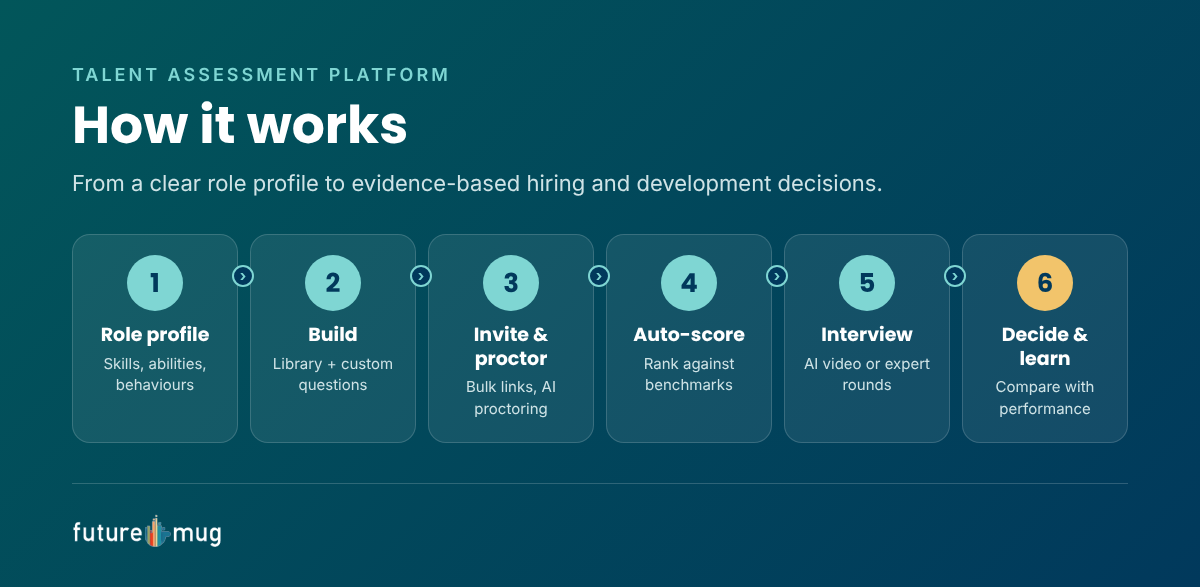
- Define the role profile. List the skills, abilities and behaviours the job needs.
- Build the assessment. Combine library tests and custom questions into one assessment.
- Invite and proctor. Send links in bulk, and use AI proctoring to keep remote results trustworthy.
- Score automatically. The platform scores answers and ranks candidates against your benchmarks.
- Confirm with interviews. Move top scorers into AI video interviews or expert interviews.
- Decide and learn. Hire, promote or train, then compare scores with real performance to improve the next assessment.
7 Types of Talent Assessment
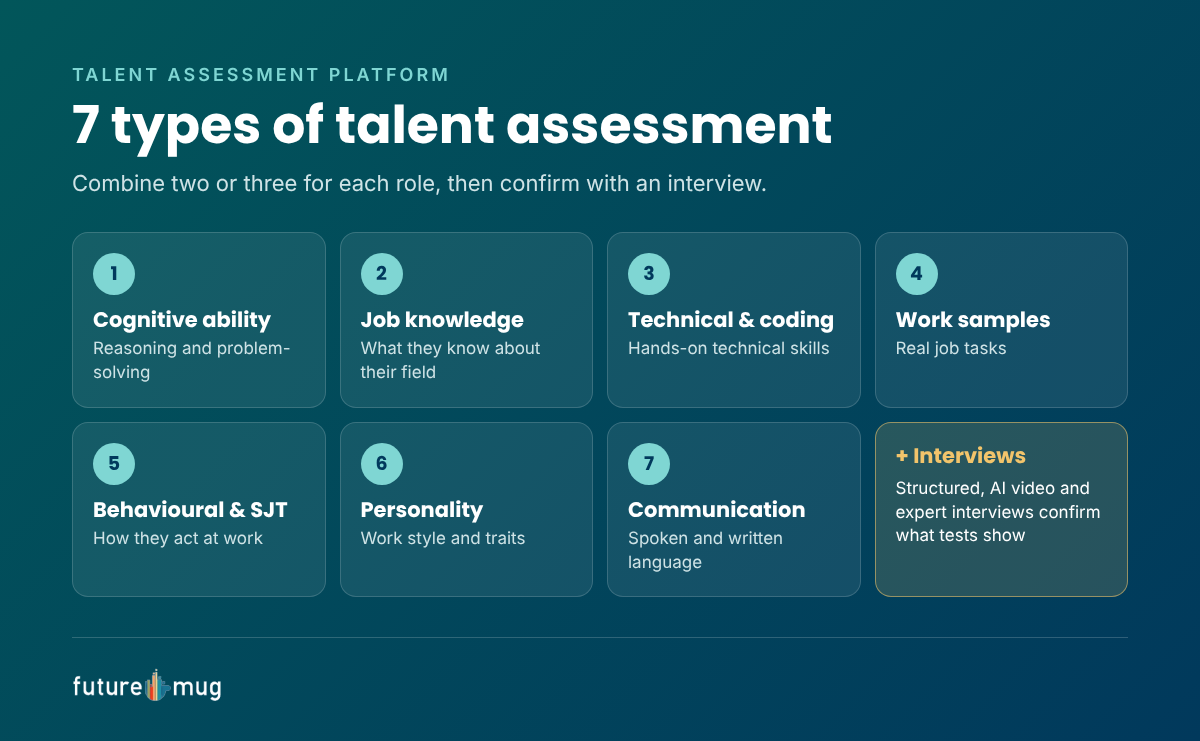
A good talent assessment platform runs several of these, so you can combine them for each role:
|
Type |
What it measures |
Typical use |
|---|---|---|
|
1. Cognitive ability (aptitude) |
Reasoning, learning and problem-solving |
Freshers, graduate programmes, high-volume roles |
|
2. Job knowledge and domain |
What a person knows about their field |
Experienced and specialist hires |
|
3. Technical and coding |
Hands-on programming and technical skills |
Developers, IT and data roles |
|
4. Work samples and simulations |
Performance on real job tasks |
Support, sales, operations, analysts |
|
5. Behavioural and situational judgement |
How people act in work situations |
Customer-facing roles, team leads |
|
6. Personality and work style |
Work-related traits and preferences |
Team fit, leadership, development plans |
|
7. Communication and language |
Spoken and written communication |
BPO, client-facing and global roles |
Interviews complete the picture. Structured interviews, AI video interviews and expert technical interviews confirm what the tests show.
For a deeper look at how to choose and combine tests, see our guides to pre-employment assessment tests and behavioral assessments for hiring.
Where It Fits Across the Talent Lifecycle
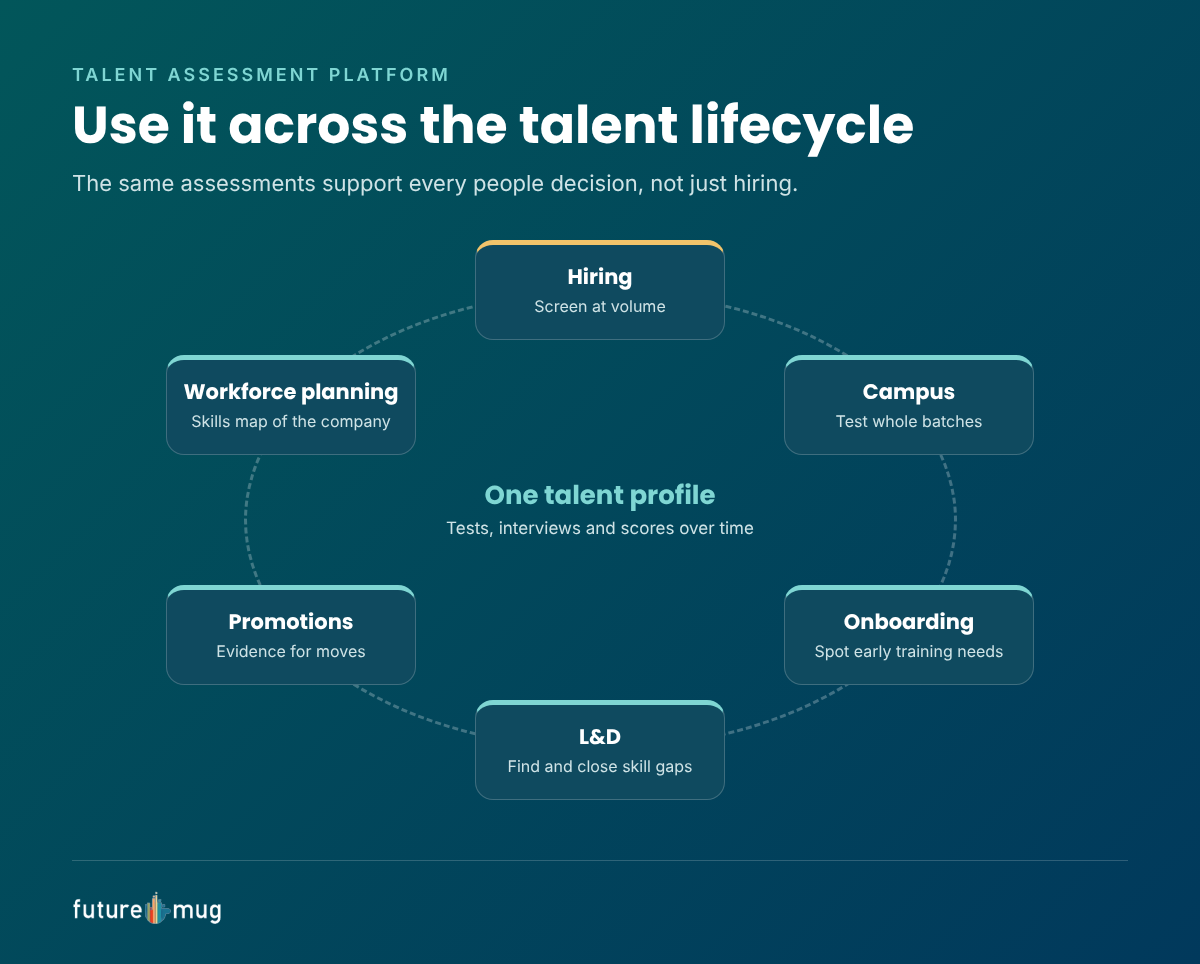
A talent assessment platform isn’t only for hiring. The same tests can support people decisions at every stage:
- Hiring: screen applicants at volume, shortlist on evidence and reduce mis-hires.
- Campus recruitment: test hundreds of students in one drive, then move top scorers to interviews.
- Onboarding: spot where new hires need extra training in their first months.
- Learning and development: find skill gaps by team and measure whether training worked.
- Promotions and internal mobility: add objective evidence to promotion and redeployment decisions.
- Workforce planning: build a skills map of the organisation to plan future hiring and training.
Benefits for TA and HR leaders
- Faster screening: automated tests replace manual resume reading and first-round calls.
- Fairer decisions: every candidate is judged on the same standard.
- Better quality of hire: decisions rest on skills, not CVs alone.
- Defensible data: scores and reports explain why each decision was made.
- One view of talent: hiring and development data in one place.
How to Choose a Talent Assessment Platform
- Assessment range: does it cover the types you need, from aptitude and coding to behavioural and communication?
- Custom tests: can you build role-specific assessments, not only use a library?
- Validity: are tests built and reviewed by subject experts, and can the vendor show how they relate to job performance?
- Proctoring and integrity: AI proctoring, identity checks and question randomisation.
- Interviews included: can top scorers move straight to AI video or expert interviews?
- Scale: can it handle a full campus drive or a bulk hiring push without slowing down?
- Analytics: clear reports for recruiters, and skills data for HR and L&D.
- Integrations and security: ATS and HRMS connections, role-based access and secure data storage.
- Support and pricing model: onboarding help, a pilot or free plan, and pricing that fits your volumes.
Comparing vendors? See our list of the 15 best online assessment platforms in India.
Talent Assessment Platform Acquisitions: A Consolidating Market
The talent assessment market is consolidating. Larger HR tech and consulting firms are buying assessment specialists to add skills data to their platforms. Some notable deals:
|
Date |
Deal |
What it means |
|---|---|---|
|
Oct 2018 |
Mercer acquired Gurugram-based Mettl (Business Standard) |
Mercer’s entry into talent assessment |
|
Jan 2025 |
Karat acquired Byteboard (Karat) |
Project-style technical assessments added to interviewing |
|
Feb 2026 |
Phenom acquired Be Applied (Reworked) |
AI-driven cognitive assessment added to a talent platform |
|
Mar 2026 |
Findem’s acquisition of Glider AI reported (ERE) |
Assessment and hiring data combined with talent intelligence |
|
Sep 2026 |
Harver acquired Symphony Talent (Harver) |
Assessment provider adds recruitment marketing |
What this means for buyers: ask any vendor about its roadmap and ownership, check that your data can be exported, and favour platforms that already connect assessments with interviews and hiring, so you aren’t left stitching tools together after the next deal.
How futuremug Helps
futuremug is a talent assessment platform built for Indian employers, colleges and training institutes, with assessments and interviews in one flow:
- Online assessment platform: aptitude, coding, domain and communication tests with AI proctoring and automatic scoring. You can start free.
- AI video interviews: top scorers move straight into on-demand AI interviews with transcripts.
- Expert interviews: 5,000+ interviewers across 250+ IT domains confirm technical skills.
- Assessment outsourcing: futuremug designs and runs the full assessment for you.
- For enterprises and GCCs: assessments and interviews at scale for large hiring programmes.
Conclusion
A talent assessment platform turns hiring and development decisions into evidence-based ones. Choose one that covers the assessment types your roles need, keeps remote results trustworthy, connects tests to interviews, and gives HR usable skills data. In a market that keeps consolidating, a platform that already joins these steps saves you from stitching tools together later.
Start with futuremug’s free assessment platform or book a demo to see assessments and interviews working together.



Frequently Asked Questions
It is software that measures candidates' and employees' skills, abilities and behaviour through structured tests and interviews, with proctoring, automatic scoring and reports in one place.
A talent assessment tool usually runs one type of test, such as a coding test or a personality questionnaire. A talent assessment platform combines many test types and interviews in one system.
The main types are cognitive ability, job knowledge, technical and coding, work samples, behavioural and situational judgement, personality, and communication assessments.
Check its assessment range, custom tests, validity, proctoring, built-in interviews, scale, analytics, integrations, security and support. Then run a pilot on one role.
Yes. HR and L&D teams use the same assessments to find skill gaps, plan training, and support promotions and internal moves.
Recent deals include Karat acquiring Byteboard (2025), Phenom acquiring Be Applied (2026), Findem's acquisition of Glider AI (reported 2026) and Harver acquiring Symphony Talent (2026). Earlier, Mercer acquired India's Mettl in 2018.