
Candidate Response Rates: Why Yours Are Falling and How to Fix Them
If it feels harder than it used to be to get a reply from a candidate, you’re not imagining it — candidate response rates have been sliding across recruiting for years. Good sourcers who once expected a healthy share of replies now watch messages disappear into silence. The good news is that most of the causes are within your control, and a handful of specific changes reliably lift the rate. This is why candidate response rates are falling, and exactly how to fix yours.
|
Quick answer: A candidate response rate is the share of contacted candidates who reply to your recruiting outreach — replies divided by candidates contacted. Rates are falling because outreach has become generic and mistargeted, candidates are flooded with messages, and not replying has become normal. You lift them by making messages personal and relevant, targeting the right candidates, keeping the ask small, following up without spamming, and backing it with a fast, human process. Track your own baseline and trend, not a generic industry number. |
What a Candidate Response Rate Is
A candidate response rate is simply the share of candidates you contact who reply to your recruiting outreach — replies received divided by candidates contacted. It’s a top-of-funnel metric: it doesn’t measure hires, or even interviews, but whether your sourcing messages are good enough to start a conversation at all. When your candidate response rate falls, everything downstream shrinks with it, which is why it’s worth treating as a number to actively manage rather than accept.
Why Candidate Response Rates Are Falling
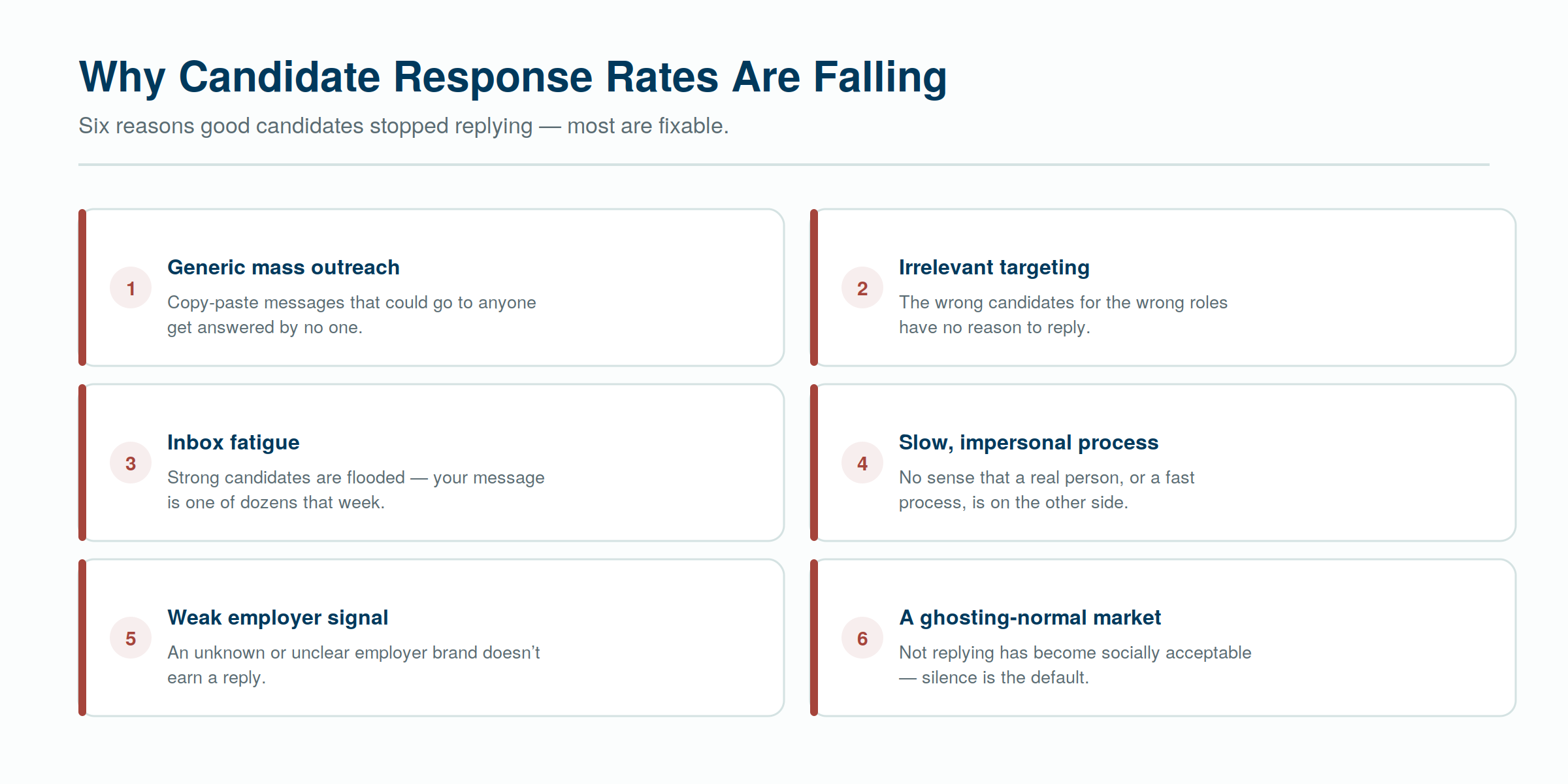
The decline isn’t one thing — it’s several reinforcing ones. Naming which apply to you is the first step, because the fix for a targeting problem is different from the fix for a message-quality problem.
Generic mass outreach. The biggest culprit. A message that could have been sent to anyone gets a reply from no one — and candidates have learned to spot a template instantly.
Irrelevant targeting. When candidates are contacted about roles that don’t fit their skills or trajectory, they have no reason to engage, and repeated mismatches train them to ignore recruiters entirely.
Inbox fatigue and a ghosting-normal market. Strong candidates receive more recruiter messages than they can answer, so most go unanswered by default — and not replying has become socially acceptable in a way it wasn’t a decade ago.
A slow or invisible process. If nothing about the outreach signals a fast, human process or a credible employer, replying feels like a gamble candidates decline to take.
How to Fix Falling Candidate Response Rates
Every cause above has a counter, and they compound: fix two or three and the candidate response rate moves noticeably. The highest-leverage fixes are about message quality and targeting.
Personalise, and target so you can. Reference something specific to the candidate and make the relevance of the role obvious. This takes more time per message — so contact fewer, better-fit candidates rather than blasting a generic message to hundreds. Fewer, sharper messages beat volume almost every time.
Keep the ask small and human. One clear, low-effort next step — a short call, not a form or a full application — and a sign-off from a real person, not a no-reply address. Then follow up once or twice, spaced out, without tipping into spam.
Back it with speed. Make sure the process behind the message is fast and respectful, because candidates can sense a slow pipeline and it suppresses replies. The experience you offer after “yes” is part of why people say yes.
Write Messages Candidates Actually Answer
Since message quality is the biggest lever, it’s worth seeing what a reply-getting message is actually made of. The parts are simple; the discipline is doing all of them, every time.
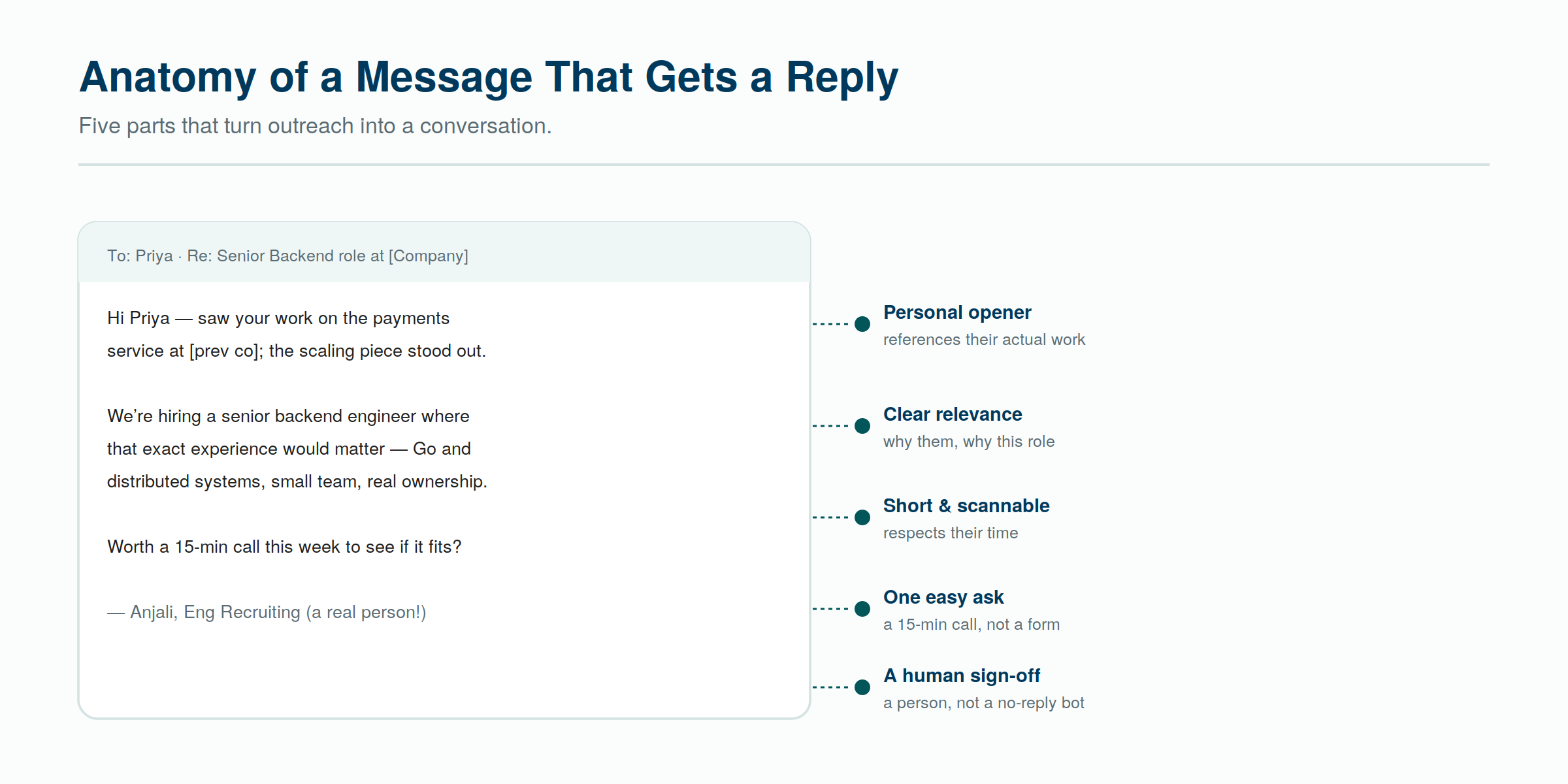
None of these parts is clever on its own — the power is in the combination. A message that’s personal but has a huge ask fails; a short one that’s generic fails; a relevant one signed by a no-reply bot fails. Get all five right and a cold message starts reading like the beginning of a conversation, which is exactly what a candidate response rate measures.
Measure and Benchmark Your Candidate Response Rate
You can’t improve what you don’t track, and here the tracking is easy — the discipline is doing it consistently and honestly.
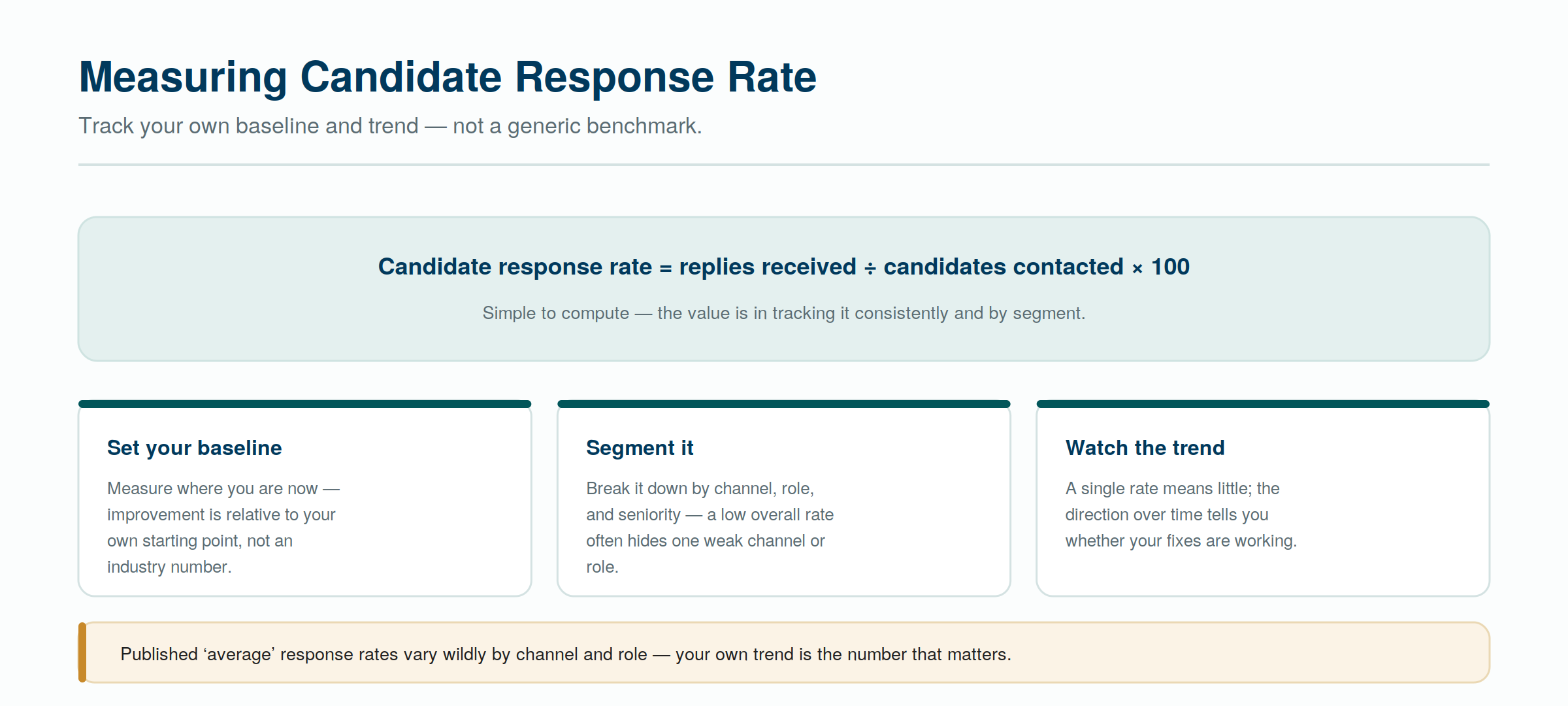
Ignore the published averages. Candidate response rates vary so widely by channel, role, seniority, and outreach warmth that any industry ‘average’ tells you almost nothing about your situation. Measure your own baseline, segment it by channel and role so a single weak spot doesn’t hide behind an overall figure, and watch the trend as you apply the fixes above. The direction of your own number is the only benchmark that matters.
Falling candidate response rates aren’t just a fact of a tougher market — they’re mostly the result of outreach that’s become too generic, too broad, and too impersonal, and all three are fixable. Target better so you can personalise, keep the ask small and human, back it with a fast process, and track your own baseline and trend. Do that, and you’ll pull your candidate response rate back up while the recruiters still blasting templates keep watching their messages vanish.
One last point that’s easy to miss: response rate gets candidates in the door, but a slow process loses them anyway. Keeping the candidates your outreach worked to engage means a fast, respectful interview process — which is where structured AI and human interviews help, by making sure the experience after “yes” matches the effort it took to earn it.



Frequently Asked Questions
It's a recruiting metric: the percentage of candidates you contact who reply to your outreach, calculated as replies received divided by candidates contacted, times 100. It measures how effective your sourcing messages are at starting a conversation — not how many people you hire, but how many engage at all. It's one of the earliest signals that your top-of-funnel outreach is working or failing.
Six main reasons: outreach has become generic mass messaging that could go to anyone, candidates are targeted for roles that don't fit, strong candidates are flooded with recruiter messages, the process behind the message feels slow or impersonal, the employer brand isn't strong enough to earn a reply, and ghosting has become socially normal. Most of these are within a recruiter's control — which is why response rates are fixable, not just a fact of the market.
There's no single good number — it varies enormously by channel, role, seniority, and how warm the outreach is, so any published 'average' is close to meaningless for your situation. The useful benchmark is your own: measure your current baseline, segment it by channel and role, and track whether it's trending up as you improve your outreach. Direction matters more than any absolute figure.
Personalise the opener with something specific to the candidate, make the relevance obvious (why them, why this role), keep the message short with one easy ask, sign off as a real person, and follow up once or twice without spamming. Target better so you're only contacting people the role actually suits, and make sure the process behind the message is fast — candidates can sense a slow, impersonal pipeline. Small changes to message quality often move the rate the most.
Yes — it's the single highest-leverage change for most teams. A message that references a candidate's actual work and explains why this specific role fits them reads completely differently from a template, and candidates reply to the former far more often. It costs more time per message, which is why targeting matters: contacting fewer, better-fit candidates with genuinely personal messages beats blasting a generic one to hundreds.
Response rate gets candidates in the door; the process keeps them from leaving. A slow, impersonal, or drawn-out interview process causes ghosting later in the funnel even when initial response was strong. A fast, structured, respectful process — the kind AI-structured interviews and prompt scheduling enable — protects the candidates your outreach worked to engage.