How to Improve Employer Branding in Recruitment: Candidate Perception of Your Employer Brand

What is employer branding in recruitment?
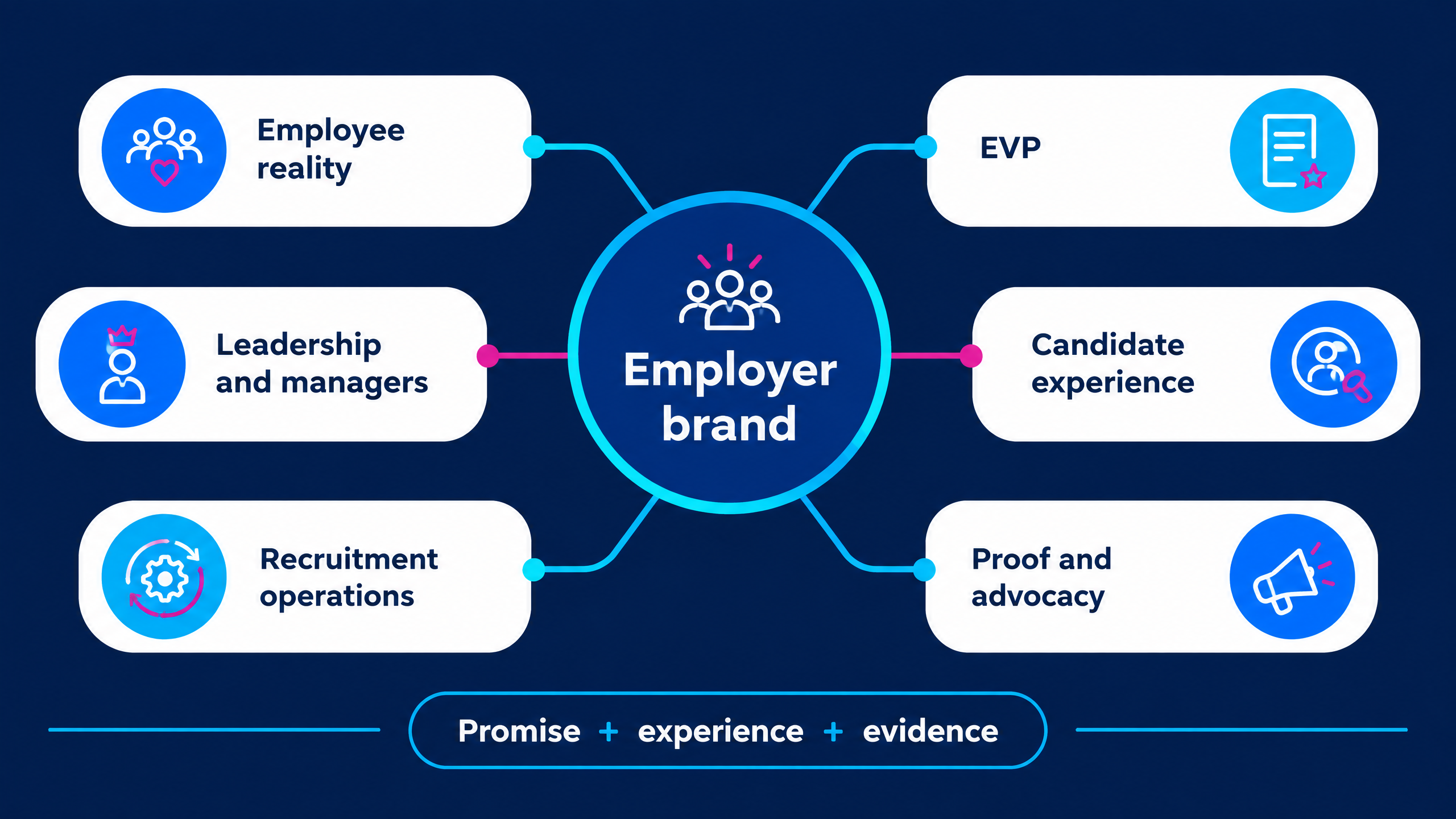
Employer branding in recruitment is the way an organization shapes, communicates, and delivers its reputation as a place to work throughout the hiring journey. It includes the stories, proof, expectations, interactions, and decisions that influence how potential candidates perceive the organization before they apply, while they are being evaluated, and after they receive an outcome.
Employer branding is broader than a careers-page slogan. It is shaped by leadership behavior, manager quality, employee development, compensation philosophy, flexibility, inclusion, communication, hiring decisions, and the day-to-day experience of work. Recruitment is where many candidates first test whether the employer promise appears credible.
A useful employer brand helps candidates answer practical questions: What does this organization value? What kind of work will I do? How will I grow? Who will manage me? How are decisions made? Will the company communicate clearly? Will I be treated fairly if I am not selected?
The strongest employer brands do not claim to be perfect. They explain what the organization is building, where it is improving, and what people can realistically expect. Specificity makes the promise more believable and helps the right candidates make an informed decision.
For a broader foundation, read futuremug’s .
Candidate perception is shaped by the complete experience, not only by careers-page messaging.

Why candidate perception matters

Candidates compare more than salary and job title. They assess reputation, leadership, learning, flexibility, purpose, stability, inclusion, manager quality, growth, and the experience of the hiring process itself.
Candidate perception affects whether a person notices a role, clicks through, completes an application, responds to outreach, finishes an assessment, attends an interview, accepts an offer, recommends the company, or considers the organization again later.
It also influences the quality of the talent relationship. When the external promise resembles the actual experience, candidates can self-select more accurately. When the promise and experience conflict, the organization may attract attention but lose trust during the process.
Candidate outcome
Employer-brand connection
Awareness
Clear stories and proof help the right people notice the organization.
Relevance
Specific role, team, work, and growth information helps candidates assess fit.
Application
Transparent requirements and a usable application reduce avoidable friction.
Continuation
Timely communication and predictable stages encourage candidates to stay engaged.
Trust
Consistent evaluation and respectful treatment make the employer promise more credible.
Offer acceptance
The recruitment experience helps candidates judge whether the opportunity is real.
Advocacy
Positive experiences give employees and candidates reasons to speak well of the brand.
Employer branding is therefore not only a marketing activity. It is a cross-functional responsibility shared by employer-brand teams, recruiters, hiring managers, interviewers, operations teams, people leaders, and employees.

Employer brand, employer branding, and candidate experience

An employer brand is the overall perception people hold about an organization as a place to work. Employer branding is the ongoing work used to understand, shape, communicate, and improve that perception. Candidate experience is the sequence of interactions a person has while considering, applying to, and moving through the hiring process.
Concept
What it means
Who shapes it
Employer brand
The reputation and associations people hold.
Employees, candidates, leaders, recruiters, managers, and the wider market.
Employer branding
The strategy and activities used to influence that reputation.
Employer-brand, HR, communications, TA, and business teams.
Candidate experience
The lived experience of the recruitment journey.
Recruiters, interviewers, systems, hiring managers, and support teams.
These concepts must work together. A strong campaign cannot repair an interview process that feels disorganized. A polished careers page cannot compensate for unexplained delays. An attractive EVP cannot create trust if candidates never receive a clear next step.

The candidate perception journey

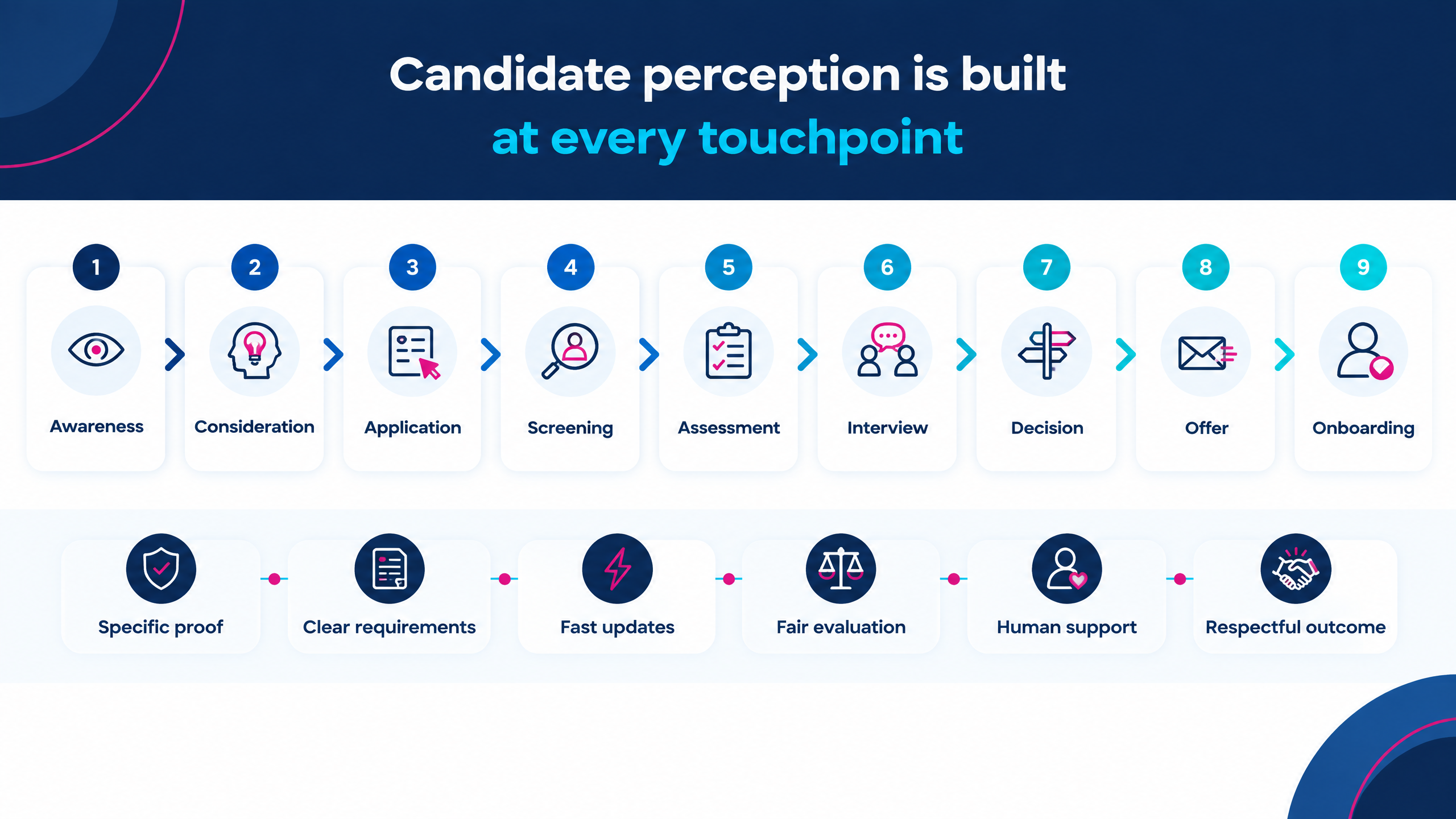
A candidate may encounter the employer through a search result, employee post, referral, campus event, recruiter message, job board, assessment invitation, interview, offer conversation, or rejection note. Each interaction either reinforces or weakens the employer brand.
Journey stage
Candidate question
Employer-brand opportunity
Awareness
Why should I notice this organization?
Show specific work, people, purpose, and outcomes.
Consideration
Could I belong and succeed here?
Explain culture, role expectations, growth, leadership, and flexibility.
Application
Is this process worth my time?
Make requirements, steps, timelines, and accessibility clear.
Screening
Will I be evaluated fairly?
Use relevant criteria, consistent communication, and respectful interactions.
Assessment
Does this test reflect the role?
Explain what is measured, how long it takes, and how support works.
Interview
What will working here feel like?
Prepare interviewers and give candidates space to ask questions.
Decision
Can I trust the organization?
Communicate promptly, explain next steps, and handle outcomes professionally.
Offer
Is the promise real?
Connect role, manager, growth, rewards, and work environment to evidence.
After joining
Did the experience match expectations?
Use onboarding and listening to close the promise-delivery gap.
Recruitment operations are therefore part of the employer experience. Slow scheduling, unclear instructions, inconsistent interviews, missing feedback, and silence after an interview can undermine a carefully designed campaign.

10 practical ways to improve employer branding in recruitment

1. Define the employer-brand problem before creating content

Clarify what the organization needs the strategy to improve. The objective may be stronger awareness in a new talent market, better quality of applicants, higher offer acceptance, greater diversity, improved campus attraction, faster hiring, or reduced early attrition.
A clear problem prevents employer branding from becoming a collection of disconnected posts. It also helps CHROs and TA leaders decide which audiences and moments deserve priority.

2. Segment audiences by role and decision criteria

Different candidates need different evidence. A software engineer may care about technical autonomy, architecture challenges, and learning. A sales candidate may focus on enablement, targets, manager coaching, and earning potential. A graduate may want structured development, mentorship, and a credible first role.
Map audiences by role, seniority, location, career stage, and decision criteria. Adapt the message without creating contradictions in the overall employer-brand promise.

3. Research current perception

Use employee listening, candidate feedback, recruiter observations, review sites, exit interviews, acceptance and rejection reasons, social listening, and competitor analysis. Look for the difference between what the organization wants to be known for and what people currently experience.
Research should include positive and negative signals. A strategy built only around leadership preference may miss what candidates and employees actually need to know.

4. Create a specific employee value proposition

The employee value proposition, or EVP, describes the value an organization offers in exchange for the skills, contribution, and commitment of its people. A strong EVP is specific enough to guide decisions and flexible enough to reflect different roles.
It may include meaningful work, learning, leadership, rewards, flexibility, community, inclusion, and growth. Avoid generic language that could describe any employer. A credible EVP should connect to the organization’s work, customers, people, and operating reality.

5. Build a proof library

For every EVP pillar, identify evidence. Gather employee stories, project outcomes, learning journeys, manager examples, customer impact, community initiatives, workplace practices, and candidate-process improvements.
Establish consent, privacy, accuracy, and review processes before publishing personal stories or images. Candidates are more likely to trust specific proof than broad claims such as “we are a great place to work.”

6. Make job content realistic and useful

Job descriptions should explain the work, team, manager relationship, required capabilities, location, work model, interview stages, development opportunities, and likely challenges. Do not hide important constraints behind attractive language.
Realistic job content helps candidates self-select. It may reduce some applications, but it can improve relevance and reduce disappointment later in the process.

7. Design a respectful candidate experience

Make it easy to understand the process, complete each step, ask for help, request an accommodation, and know what happens next. Keep instructions short, use accessible language, and reduce unnecessary forms.
Candidate experience includes speed, but speed is not the only measure. Candidates also need clarity, fairness, consistency, privacy, and human support when a situation is unusual.
For related operational guidance, connect this article to futuremug’s .

8. Enable recruiters and interviewers

Recruiters, hiring managers, interviewers, employees, and leaders all represent the employer brand. Give them message guidance, candidate-experience standards, interview training, escalation routes, and examples of what good communication looks like.
Interviewers should understand how to explain the role, create psychological safety, ask relevant questions, avoid inappropriate topics, record evidence, and close the conversation respectfully.

9. Connect brand promises to hiring operations

A promise about speed is weak if scheduling takes weeks. A promise about inclusion is weak if the assessment is inaccessible. A promise about learning is weak if the recruiter cannot explain development paths.
Review how the employer promise appears in job pages, outreach, screening, assessments, interviews, offers, onboarding, and employee advocacy. Every stage should tell a consistent story while providing the information appropriate to that moment.

10. Measure, learn, and improve continuously
Track awareness, qualified traffic, application conversion, response rates, completion, interview attendance, candidate feedback, offer acceptance, source quality, diversity indicators, early attrition, and employee advocacy.
Review qualitative feedback alongside performance data. Numbers may show that candidates drop off, but interviews and comments help explain whether the cause is a confusing requirement, slow scheduling, unclear assessment instructions, poor communication, or a mismatch between promise and reality.
Employer branding in recruitment infographic showing the candidate journey from awareness to application, assessment, interview, offer, and onboarding with brand trust signals at each stage

How recruitment operations strengthen or weaken the brand

Employer-brand teams often own the story, but recruitment operations deliver much of the experience. That means process decisions deserve the same attention as campaign creative.

Job discovery and application

Candidates should quickly understand what the organization does, what the role involves, what is required, and what the process looks like. Forms should ask for relevant information and work well on common devices.

Screening and assessment

Screening should use criteria connected to the role. Assessments should have clear instructions, realistic time expectations, appropriate accessibility support, and a transparent route for technical issues or exceptional circumstances.
If an AI-assisted tool is used, explain its role accurately. Avoid suggesting that software can understand every candidate perfectly. Human review should remain available for ambiguity, accommodation, disputed outcomes, and consequential decisions.

Interview scheduling

Scheduling is often one of the most visible signals of operational quality. Candidates notice whether the organization can coordinate calendars, provide accurate links, send reminders, handle rescheduling, and respond when something goes wrong.
Automation can reduce back-and-forth, but candidates should always have a way to reach a person when they need help. A smooth process feels organized without becoming impersonal.

Feedback and decisions

Candidates may not receive detailed feedback after every stage, but they should receive timely status updates and clear next steps. Rejection communication should be professional and respectful. When appropriate, future consideration or improvement guidance can help preserve the relationship.

Offers and onboarding

An employer promise is tested strongly after selection. Offer materials, compensation explanations, documentation, pre-joining communication, manager introductions, and onboarding should reflect what candidates heard during recruitment.

What to automate and what to keep human

Responsible employer branding in recruitment depends on a clear division of labor. Software can enforce a workflow, send a reminder, compare availability, calculate a score, produce a summary, or identify a missing step. People should define requirements, approve criteria, review exceptions, interpret evidence, and make consequential decisions.
Recruitment activity
Good automation opportunity
Human responsibility
Candidate intake
Forms, imports, duplicate checks, and profile creation.
Confirm required information and consent.
Scheduling
Availability matching, calendar links, reminders, and rescheduling.
Resolve exceptions and candidate needs.
Assessment
Invitations, timers, scoring, proctoring, and reports.
Set job-relevant tests and review outcomes.
Interview workflow
Templates, structured rubrics, transcripts, and feedback prompts.
Evaluate evidence and make accountable decisions.
Communication
Status notifications, next steps, and reminders.
Approve language and handle sensitive conversations.
Reporting
Funnel dashboards, stage timing, and experience summaries.
Decide which improvements to make.
Every automated action should have a clear owner and observable status. Teams should monitor candidate complaints, accessibility barriers, inconsistent messages, false positives, false negatives, and outcomes across relevant groups.
Review the as a useful external reference when AI-enabled recruitment tools influence candidate progression. For accessibility considerations, consult the .

How to measure candidate perception

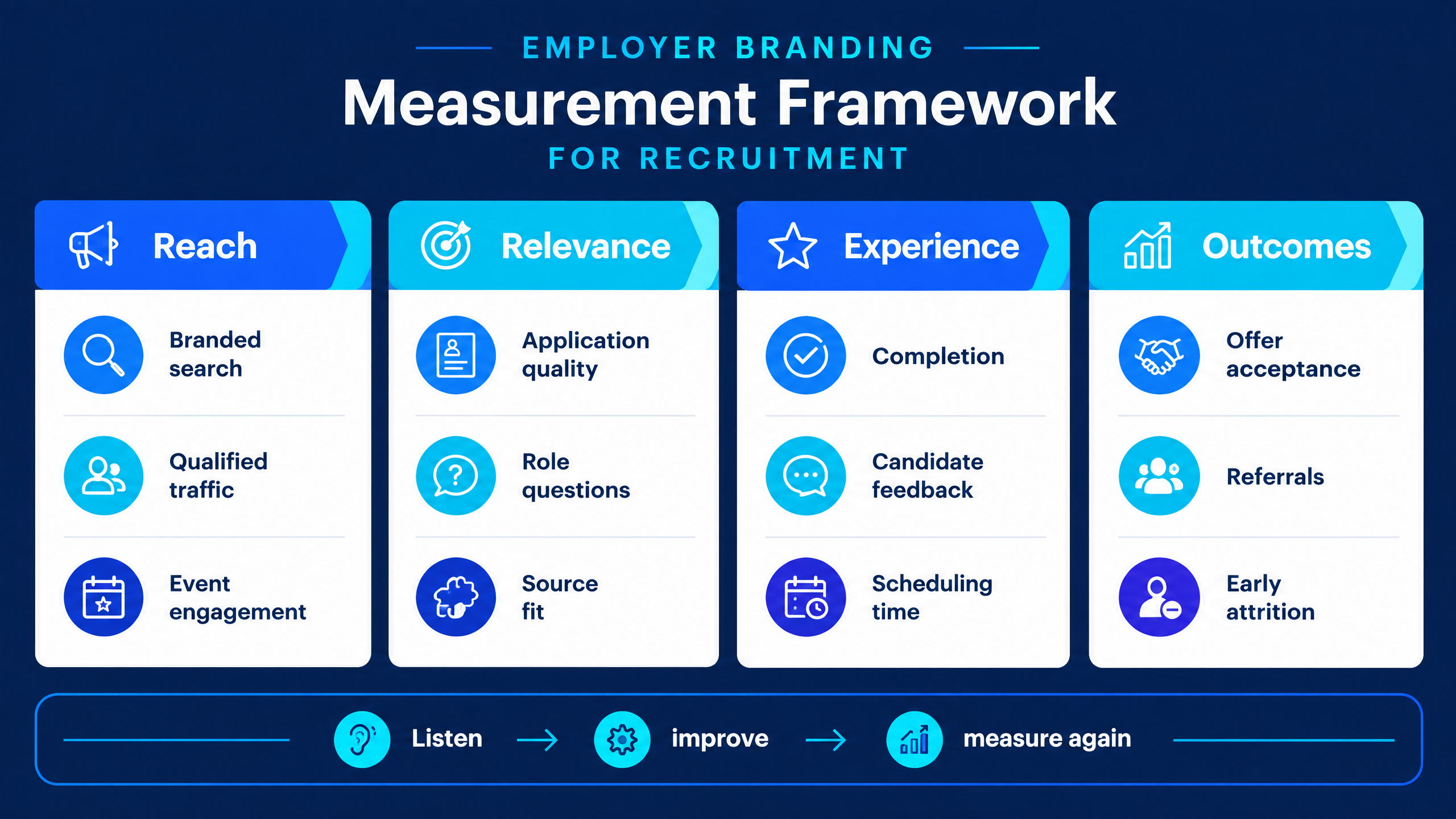
A practical measurement model combines perception, behavior, experience, and business outcomes.
Measurement area
Example questions
Useful signals
Awareness
Are the right candidates discovering the employer?
Branded search, qualified traffic, event engagement, source reach.
Relevance
Do candidates understand the role and experience?
Job-page engagement, application quality, role-specific questions.
Process experience
Is the hiring journey clear and respectful?
Candidate surveys, completion, scheduling time, complaints, support requests.
Trust
Do candidates believe the organization’s promise?
Offer acceptance, interview feedback, review themes, referral intent.
Fairness
Are candidates evaluated consistently?
Stage outcomes, accommodation requests, audit findings, exception patterns.
Advocacy
Would people recommend the organization?
Employee sharing, candidate referrals, recommendation scores, testimonials.
Business impact
Does the strategy support hiring outcomes?
Quality, time-to-stage, early attrition, joining, retention, and cost.
Do not treat one score as the employer brand. A candidate may like the content but dislike the process. An employee may value the culture but question career progression. Combine data sources and review trends over time.
Employer branding in recruitment infographic showing a measurement framework across reach, relevance, candidate experience, and hiring outcomes

How to build an employer-brand improvement plan

First 30 days: listen and map

Interview recruiters, hiring managers, employees, candidates, and recent joiners. Map the current candidate journey from awareness through onboarding. Collect examples of effective experiences and recurring friction.

Days 31–60: prioritize and design

Select the highest-impact gaps. Define the EVP pillars, audience segments, proof library, communication standards, candidate-experience principles, process owners, and measurement baseline.

Days 61–90: pilot and learn

Choose one role family, location, or candidate segment. Improve the relevant job content, outreach, assessment instructions, interview experience, communication cadence, and feedback loop. Compare the pilot with the previous process.

Ongoing: scale with governance

Create ownership across employer brand, TA, HR operations, hiring managers, communications, legal, privacy, accessibility, and leadership. Review performance monthly or quarterly and update the strategy when the employee or candidate reality changes.

Explore related futuremug resources

Use the related resources to connect employer-brand strategy with the recruitment moments that candidates actually experience. A compelling promise becomes more credible when the hiring process delivers clarity, consistency, fairness, and respect.

Frequently Asked Questions

What is employer branding in recruitment?

Employer branding in recruitment is the way an organization shapes and delivers its reputation throughout the hiring journey. It includes employer stories, job content, recruiter communication, assessment and interview experience, offers, and the consistency between the employer promise and reality.

Why is candidate perception important?

Candidate perception influences whether people apply, continue, attend interviews, accept offers, recommend the organization, or consider it again. A credible experience helps candidates make informed decisions and supports stronger long-term talent relationships.

How is employer branding different from recruitment marketing?

Recruitment marketing focuses on attracting attention and generating interest. Employer branding is broader: it includes the reputation, employee reality, candidate experience, hiring process, leadership behavior, and proof that support or contradict the message.

How can employer-brand teams improve candidate experience?

Start by mapping the candidate journey, simplifying unclear steps, improving job content, standardizing recruiter and interviewer communication, reducing scheduling delays, making assessments accessible, providing timely status updates, and creating a human escalation path.

Can recruitment automation improve employer branding?

Yes, when it reduces avoidable delays and improves consistency. Automation can support scheduling, reminders, assessment invitations, status updates, and reporting. It should not remove human judgment from exceptions, accommodations, sensitive conversations, or final decisions.

How do you measure employer branding in recruitment?

Use a combination of awareness, application quality, process completion, candidate feedback, interview attendance, offer acceptance, recommendation intent, employee advocacy, early attrition, and hiring outcomes. Segment results by role, location, source, and candidate stage where appropriate.

What role do employees play in employer branding?

Employees provide the most credible proof of workplace reality when their stories are voluntary, accurate, and representative. Employer-brand teams should make advocacy easy without pressuring employees to publish or speak in ways that do not reflect their experience.

How should a company handle a gap between its promise and reality?

Acknowledge the gap, identify the operating cause, communicate honestly, and create an improvement plan. Updating the message without improving the experience may produce short-term attention but can reduce trust later.

Leave a Reply

Your email address will not be published.