
Best Interview as a Service Platform in India
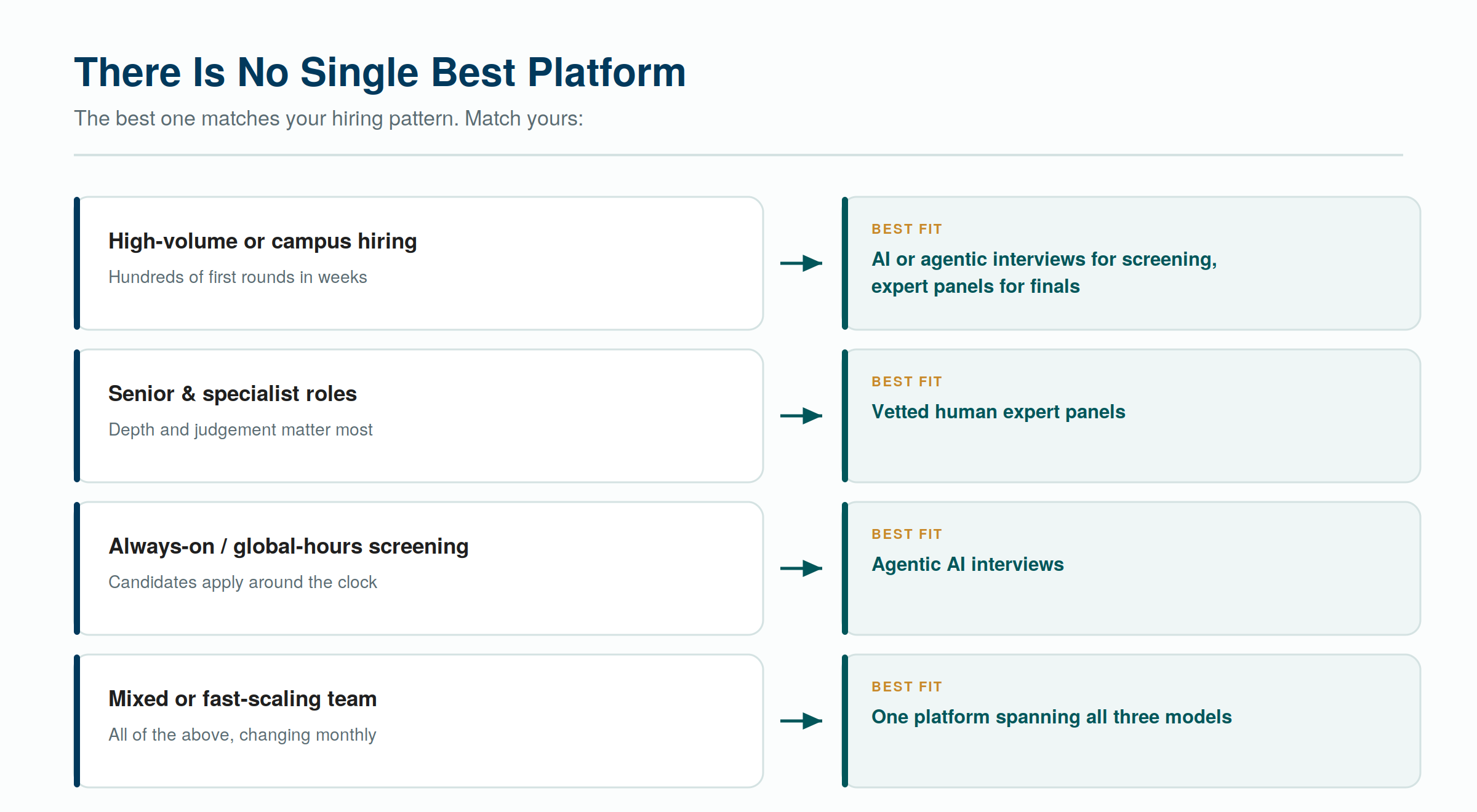
If you are shortlisting vendors, the honest headline is this: there is no single best interview as a service platform, because “best” depends on what you are hiring for. A platform that is perfect for two thousand campus interviews is the wrong tool for a principal-engineer hire. This guide gives you what a ranking of names cannot — a way to identify the best platform for your situation: the four provider types, an eight-point scorecard, the flags that separate substance from a good deck, and the best fit by hiring need.
|
Quick answer: There is no single best interview as a service platform — the best one matches your hiring pattern. High-volume and campus hiring is best served by AI or agentic interviews with expert panels for finals; senior and specialist roles by vetted human panels; always-on screening by agentic AI; and mixed, scaling teams by one platform spanning all three. Score every shortlist on interviewer vetting, calibration, AI validation, turnaround, evidence, DPDP compliance, integration, and a reference at your scale. |
What “Best” Actually Means Here
“Best interview as a service platform” is a buyer-dependent question wearing an absolute-sounding label. The variable that decides it is your hiring shape, along four axes: volume (a handful of hires a quarter, or hundreds in a campus window), seniority (junior-heavy screening, or senior and specialist depth), timing (scheduled drives, or always-on global-hours applications), and compliance load (a startup’s light needs, or an enterprise’s DPDP and audit requirements).
Read those axes off your own hiring plan before you read a single vendor page. The rest of this guide turns them into a shortlist you can defend.
The Four Types of Interview as a Service Providers
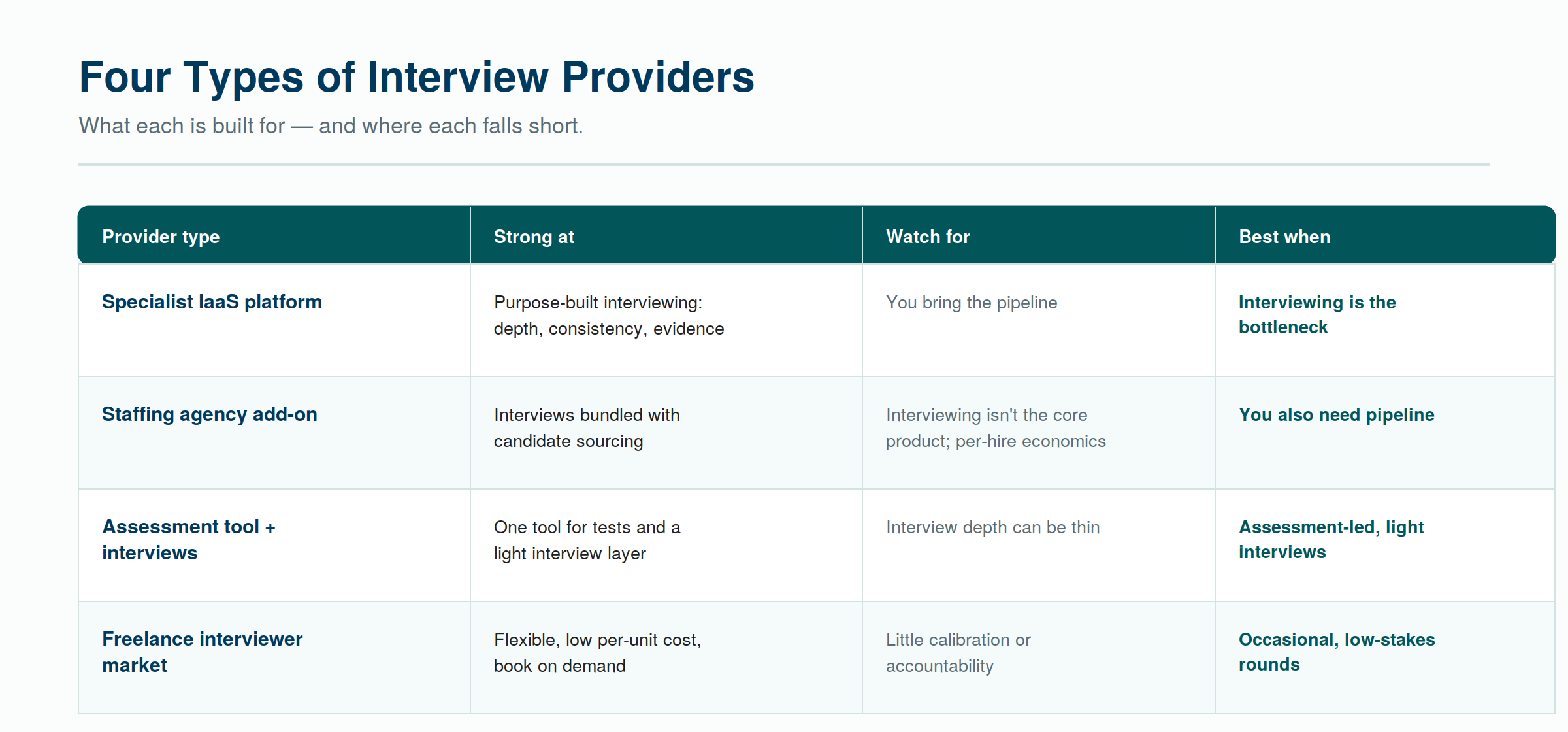
Before comparing names, compare types — the category a provider belongs to predicts its trade-offs better than its marketing does. Four types serve the Indian market.
|
Provider type |
Best when |
The trade-off |
|
Specialist IaaS platform |
Interviewing is your bottleneck |
You supply the candidate pipeline |
|
Staffing agency add-on |
You also need candidates sourced |
Interviewing isn’t the core product |
|
Assessment tool + interviews |
Assessment-led, light interview needs |
Interview depth can be shallow |
|
Freelance interviewer market |
Occasional, low-stakes rounds |
Little calibration or accountability |
For most teams whose actual problem is interview bandwidth and consistency — not a shortage of candidates — a specialist platform is the strongest starting point. The other three fit specific edges: an agency when pipeline is also thin, an assessment tool when interviews are a light add-on to testing, a marketplace for the occasional low-stakes round.
How to Score a Platform: 8 Criteria
Once you have two or three shortlisted, score them on the same eight questions and make them answer on record. This is the compact version of the scorecard from our complete buyer’s guide, which covers each in depth.
|
# |
Criterion |
The question to ask |
|
1 |
Interviewer vetting |
Who interviews, and how were they screened? |
|
2 |
Calibration |
How do scores stay consistent across interviewers? |
|
3 |
AI validation |
Is there human-agreement data on AI scores? |
|
4 |
Turnaround |
What is the median request-to-completed time? |
|
5 |
Evidence |
Do you get a recording and rubric scorecard? |
|
6 |
DPDP compliance |
Are consent, retention, and residency in the contract? |
|
7 |
Integration |
Does it fit your ATS, or add parallel admin? |
|
8 |
Reference at scale |
Can they show a client at your volume and seniority? |
Green Flags and Red Flags
Scores get you a ranking; the flags below tell you whether the ranking is real. They are the signals that separate a platform with substance from a polished sales process.
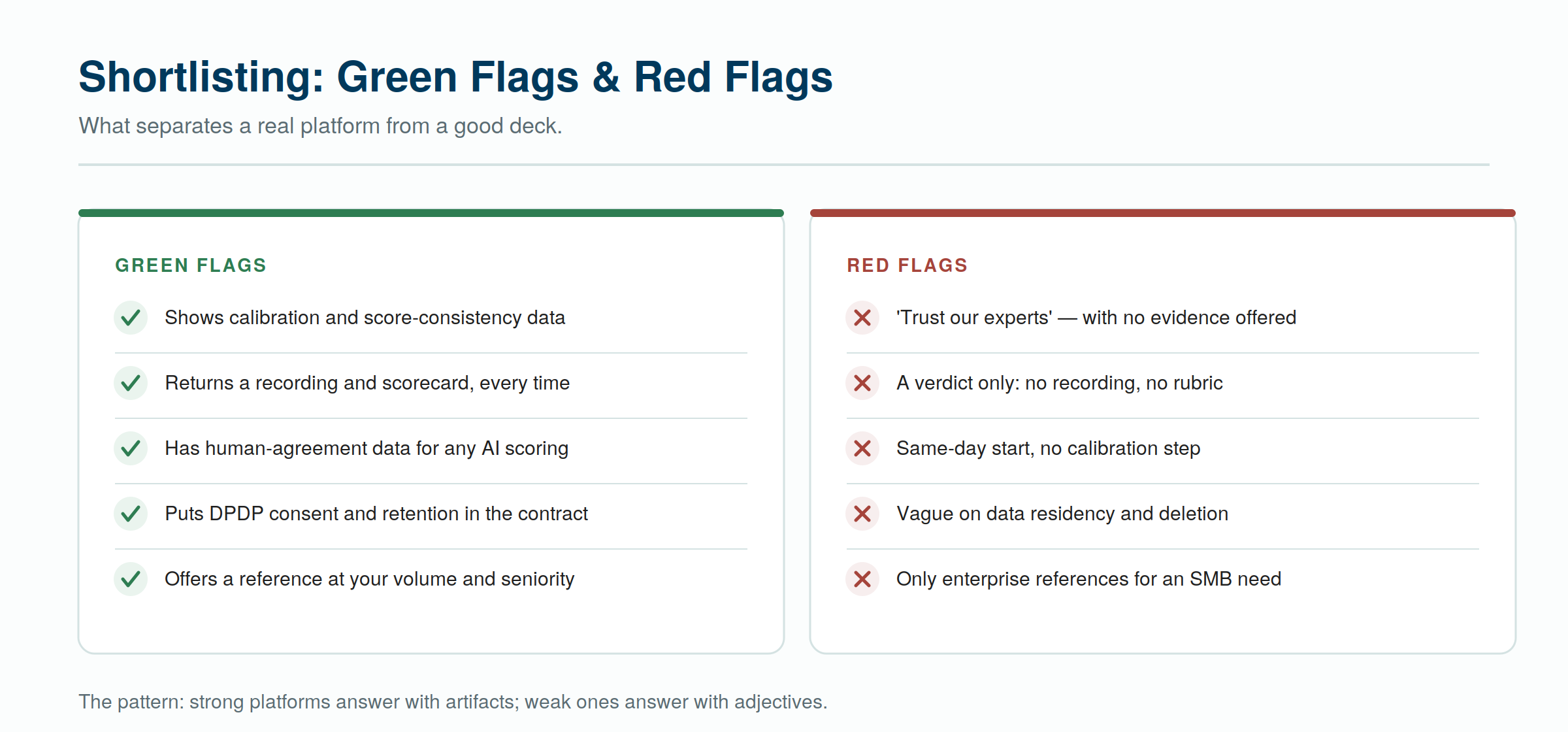
The single most useful move is to run a short paid pilot before committing — 15 to 25 real interviews with your own panel shadow-scoring a subset. Calibration surfaces in a pilot in ways it never does in a demo, and a provider that resists a paid pilot has just answered your most important question.
The Best Platform, by Hiring Need
With the types and the scorecard in hand, here is the best-fit read for each common hiring shape — the practical version of “best platform for me.”
Best for high-volume and campus hiring
When hundreds of first rounds compress into weeks, capacity is the constraint. The best platform here pairs AI-structured or agentic AI interviews for screening with human panels for finals. This is also where campus hiring platform decisions intersect — the interview layer sits inside the wider drive.
Best for senior and specialist roles
Depth beats volume here, and a rubric cannot replace a practitioner who has done the job. Expert human panels are the fit — the platform’s value is the calibre and calibration of who it puts in the room.
Best for always-on and global-hours screening
GCCs and globally distributed teams get applicants around the clock. Agentic AI interviews give always-on first-round capacity that no human panel can match on availability — validated scoring is the thing to insist on.
Best for mixed or fast-scaling teams
Most growing companies need all three within a quarter, and juggling three vendors fragments data and calibration. The best platform for this profile is one that spans human panels, AI-structured, and agentic interviews under a single rubric and dashboard — so the model follows the role without changing providers.
Where futuremug Fits
In the interest of being straight about whose guide this is: futuremug is a specialist interview as a service platform, and it is built for the “all three models” profile above. It delivers vetted human expert panels, AI-structured interviews, and agentic AI interviews under one rubric and dashboard — with the calibration, recorded evidence, and DPDP-ready data terms this guide tells you to demand.
That makes it a strong fit if interviewing is your bottleneck and your needs span volume and seniority, or shift as you scale. It is a weaker fit if your actual gap is candidate pipeline — that is an agency’s job, not a platform’s. Judge it the way this guide says to judge anyone: on the expert panels, AI interviews, and agentic AI interviews themselves, and on the evidence behind them — ideally in a pilot.
The best interview as a service platform is not a name you can look up — it is the one whose model, calibration, and evidence match your hiring shape. Read your hiring off the four axes, compare provider types before brands, score your shortlist on the eight criteria, watch the flags, and run a pilot. Choose on evidence, and the “best” for you becomes obvious.
If your shortlist wants a specialist platform spanning all three interview models, futuremug is built to be stress-tested against exactly these criteria — we would be glad to be one of the providers in your pilot.



Frequently Asked Questions
There is no universally best platform — the right choice depends on your hiring pattern. For high-volume and campus hiring, AI or agentic interviews with expert-panel finals; for senior roles, vetted human panels; for always-on screening, agentic AI; for mixed needs, a single platform covering all three. Score shortlisted providers on the same eight criteria and choose on evidence, not adjectives.
Match model to your roles, then score candidates on eight criteria: interviewer vetting, calibration, AI validation, turnaround, evidence returned, DPDP compliance, ATS integration, and a reference at your scale. Run a short paid pilot with your own panel shadow-scoring a subset — calibration shows up in a pilot in ways it never does in a demo.
They solve different problems. A staffing agency sources candidates and charges a percentage of salary; an IaaS platform interviews the candidates you already have and charges per interview. If your gap is pipeline, an agency fits; if your gap is interview bandwidth or consistency, an IaaS platform does. Many teams use both.
Fast-scaling teams usually get the most from a platform spanning all three models, because their needs change month to month — bulk screening during a funded sprint, senior panels for key hires, always-on capacity as applications grow. One provider under a single rubric keeps calibration and data intact as volume swings.
Pricing follows per-interview, retainer, or hybrid structures, with rates varying by seniority, depth, turnaround, and volume. Compare on cost per completed, calibrated interview against your own panel hours at loaded cost. The full pricing breakdown is in our interview as a service buyer's guide.
Yes, and for mixed teams that is usually the best choice. A platform offering AI and agentic interviews for volume plus vetted human panels for senior roles covers both ends under one rubric and dashboard — which keeps your scoring consistent across role types and avoids stitching data across vendors.